
It’s harder to do business when it takes too long to buy items. A missing invoice, a delayed approval, an order with the wrong supplier, or an unclear price can hold up the entire team. For hotels, restaurants, cafes, offices, and growing organisations, these tiny difficulties can soon develop into lost cash and poor service. That is why many businesses now look for simple ways to streamline your procurement process and keep daily purchasing under better control.

A clear buying process helps your staff order the right products, deal with the right suppliers, control costs, and avoid unnecessary delays. It also gives your business better visibility over what is being bought, who is buying it, and where money may be wasted.
This guide describes five practical techniques to streamline your procurement process and build a smoother supply chain.
1. Streamline Your Procurement Process with Automation
One of the biggest reasons businesses waste time is manual purchasing. Mistakes become common when staff use spreadsheets, emails, paper bills, and phone conversations. A delayed approval, incorrect price, or duplicate invoice can quickly damage supplier relationships and slow down daily work.
Automation removes many of these repetitive tasks and helps you streamline your procurement process. Your team can use a system that creates purchase orders, matches invoices, monitors approvals, and stores order records in one place. This means your team does not have to fill out every order by hand.
For example, a restaurant group may order dairy, dry store items, cleaning materials, and packaging every week. Without automation, each branch may place separate orders by phone or email. This creates confusion, especially when different branches use different suppliers or prices.
With a better system, approved suppliers, pricing, and order history become easier to manage. The business can see what was ordered, when it was ordered, who approved it, and whether the invoice matches the order.
How to Start with Procurement Automation
Begin with the most time-consuming tasks. That might include invoice matching, purchase order approval, supplier communication, or repeat ordering. Once these duties become digital, your staff can work faster and spend more time on service, stock control, and cost planning.
You do not need to change everything at once. Start with one area that causes the most delays, then improve the rest step by step.
2. Streamline Your Procurement Process with Better Supplier Data
It is difficult to make good buying decisions when supplier information is scattered across different files. One team member may have the supplier contact details. Another may have the latest price list. The finance team may have the payment terms. This creates confusion and slows down decisions.
To streamline your procurement process, all supplier information should be kept in one central place. This should include contracts, prices, delivery times, certificates, product lists, payment terms, and records of past orders.
A central supplier database puts your team in better control. It also helps prevent duplicate buying, ordering errors, and missed contract renewals. If one supplier changes their price or delivery terms, your team can see it clearly and respond quickly.
This is especially helpful for hospitality businesses. If a food supplier changes prices, a cleaning supplier misses a delivery, or a tableware supplier has a long lead time, your team needs quick access to the right information.
Why Supplier Data Matters in Procurement
Many companies lose money because they do not compare supplier prices properly. One branch might pay more for the same goods than another branch. A central system helps with spend reviews, combined orders, and better supplier rates.
It also helps your business avoid poor buying habits. When your team can clearly see approved suppliers, agreed prices, and order history, purchasing becomes more organised and less stressful.
3. Improve Supplier Relationships to Streamline Your Procurement Process
Good procurement is not only about getting the lowest price. It is also about working with reliable suppliers who understand your business. If you want to streamline your procurement process, you need suppliers who deliver on time, communicate properly, and support your organisation during busy periods.
Strong supplier relationships can help you prevent stock shortages, unexpected price changes, and poor-quality substitutes. Suppliers who understand your needs can plan better and warn you before problems develop.
This is even more important in hospitality. A late food delivery, missing cleaning product, or wrong tableware order can interrupt daily operations. Hotels, restaurants, cafes, and catering businesses need consistent suppliers to keep service running smoothly.
A good supplier can also help your business improve product quality, reduce waste, and manage stock more effectively. When both sides communicate clearly, problems are easier to solve.
What to Do with Key Suppliers
Create a list of your most important suppliers. These are the suppliers that provide products your business cannot operate without. Review their prices, delivery performance, product quality, and communication every few months.
If a supplier performs well, build a stronger relationship with them. If a supplier is often late, sends wrong products, or changes prices without warning, discuss the issue before it becomes a bigger problem.
This does not need to be complicated. A simple supplier review can help your business make better decisions and avoid repeated mistakes.
4. Set Clear Purchasing Rules for a Better Procurement Process
A business cannot control spend if everyone buys differently. Some employees may order from approved suppliers, while others may buy from random suppliers because it feels q uicker. This is often called maverick spending, and it can damage your margins.
Clear purchasing rules help you streamline your procurement process because every team member knows what to do. Your rules should explain who can make purchases, which suppliers should be used, how approvals work, and what spending limits apply.
The policy does not need to be complicated. In fact, simple rules work better. Your team should be able to understand the process quickly and follow it without confusion.
For example, everyday items should be ordered from approved suppliers only. Small purchases may need manager approval. Larger purchases may need finance or senior management approval. Any new supplier should be checked for price, quality, delivery terms, and payment conditions before the first order is placed.
Simple Procurement Policy Example
For small purchases, a manager may approve the order. For larger purchases, finance or senior management may need to approve it. Staff should use approved vendors for routine items only. Before working with a new supplier, the company should review prices, quality, delivery terms, and payment conditions.
When rules are clear, your business reduces waste and avoids unnecessary spending. It also becomes easier to track orders, manage invoices, and control supplier performance.
5. Use Procurement Data to Streamline Your Procurement Process
Every purchase tells a story. Your invoices, order history, supplier prices, and delivery records can show where your business is losing money. If you ignore this data, you may miss easy savings.
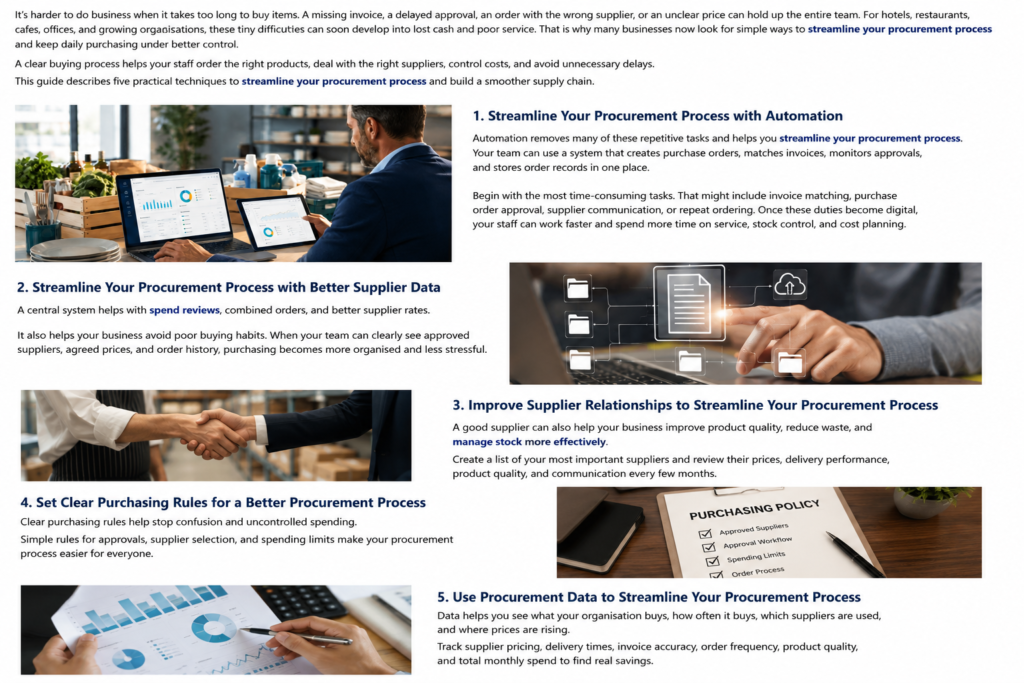
Data helps you streamline your procurement process by showing what your organisation buys, how often it buys, which suppliers are used, and where prices are rising. This makes it easier to negotiate, reduce waste, and plan future orders.
For example, your business may spend a large amount each year on cleaning supplies but buy from several different suppliers. By reviewing the data, you may find that one reliable supplier can offer better pricing if you combine your orders.
The same approach can work for food, packaging, tableware, laundry, office supplies, maintenance products, and other regular purchases. Once you understand your spending, you can make smarter decisions.
What Procurement Data to Track
Track supplier pricing, delivery times, invoice accuracy, order frequency, product quality, and total monthly spend. These simple metrics can help you make smarter decisions and protect your profit margins.
You can also track which suppliers cause the most delays, which products increase in price most often, and which branches place unnecessary emergency orders. These details help your business fix problems before they become expensive.
How ESConnect Helps Businesses Improve Procurement
ESConnect supports UK hospitality and business clients with practical procurement support, supplier management, procurement savings, and supply chain solutions. The aim is to help businesses reduce unnecessary costs, improve supplier control, and create a simpler buying process.
If your current purchasing system feels slow, unclear, or expensive, ESConnect can help you review your supplier base, identify savings, and improve how orders are managed.
With the right support, you can streamline your procurement process without making things complicated for your team. ESConnect helps businesses focus on better suppliers, clearer pricing, smoother purchasing, and stronger supply chain control.
Conclusion
A slow purchasing system can cost your business time, money, and control. But with the right steps, you can improve the way your team buys products and manages suppliers.
Start by automating manual tasks, centralising supplier data, building stronger supplier relationships, setting clear purchasing rules, and using data to find savings. These steps will help you streamline your procurement process and create a smoother supply chain.
If you want a clearer and more cost-effective way to manage purchasing, ESConnect can help you build a better procurement system for your business.
FAQs
What does it mean to streamline your procurement process?
It means making purchasing faster, clearer, and more cost-effective by reducing manual work, improving supplier control, and using better systems.
Why is procurement automation important?
Procurement automation saves time, reduces errors, speeds up approvals, and helps teams manage orders and invoices more accurately.
How can supplier management reduce costs?
Supplier management helps businesses compare prices, review performance, avoid poor suppliers, and negotiate better terms.
Which ESConnect service does this topic support?
This topic mainly supports e-procurement services, procurement savings, and supply chain management.
Can small businesses improve their procurement process?
Yes. Even small businesses can save money by using approved suppliers, clear purchasing rules, and simple order tracking.