
Buying for one restaurant or hotel is manageable. Buying for five, ten or fifty sites is a different job. Prices drift between locations, managers open their own supplier accounts, and head office loses sight of what the group actually spends.
In short: to optimise hospitality procurement across multiple locations, agree an approved product list and a small set of approved suppliers centrally, negotiate group pricing on your combined volume, give each site a simple ordering process with limited local flexibility, and review spend by site every month.
This guide explains how to set that up, what to centralise and what to leave to each site, and how to consolidate suppliers and invoices without losing quality.
Why Procurement Gets Harder as You Add Sites
The problems multi-site operators describe are remarkably consistent:
- Price drift: the same product costs different amounts at different sites because each one negotiated separately, or not at all.
- Off-contract buying: managers order from local suppliers or cash and carry when the agreed supplier is inconvenient, and group discounts are lost.
- Inconsistent products: different brands, grades and pack sizes make dishes and costs vary from site to site.
- Invoice overload: finance teams process hundreds of invoices from dozens of suppliers, with little time to check prices.
- Little visibility: without spend data by site and category, it is hard to see where money is leaking.
- Duplicate deliveries: several suppliers deliver similar products to the same sites, adding cost and receiving time.
How to Optimise Hospitality Procurement for Multiple Locations
The following steps work for restaurant groups, pub companies and hotel groups alike. The order matters: decisions about suppliers and prices only hold if they rest on good data.
- Build a spend baseline. Collect 12 months of invoices from every site and group the spend by supplier, category and location. This shows your biggest categories, your supplier count and where prices differ between sites.
- Agree a core product list. Define the products every site should use for core menu items, including brand or grade, pack size and specification. This is what makes consistent dishes and consistent costs possible.
- Choose approved suppliers per category. Most groups need one main supplier and one backup for each category. Too many suppliers dilutes your volume; too few leaves you exposed if one fails.
- Negotiate group terms on combined volume. Agree prices for the core list, but also delivery charges, minimum order values, price review notice periods, substitution rules and any rebates.
- Standardise ordering, with some local freedom. Give every site the same order guide and agreed par levels, while letting managers choose fresh produce and specials from approved suppliers.
- Check invoices against agreed prices. Price errors are common and small, which is why they go unnoticed. A central check, or an e-procurement system that matches invoices automatically, recovers this money.
- Review spend and performance monthly. Compare each site on spend with approved suppliers, price variance and food cost, and agree actions with site managers.
What Should Be Centralised and What Should Stay Local?
Centralising everything sounds efficient, but sites still need to react to bookings, weather and local events. A practical split is to centralise decisions about suppliers, prices and specifications, and leave day-to-day quantities and some fresh purchasing to each site.
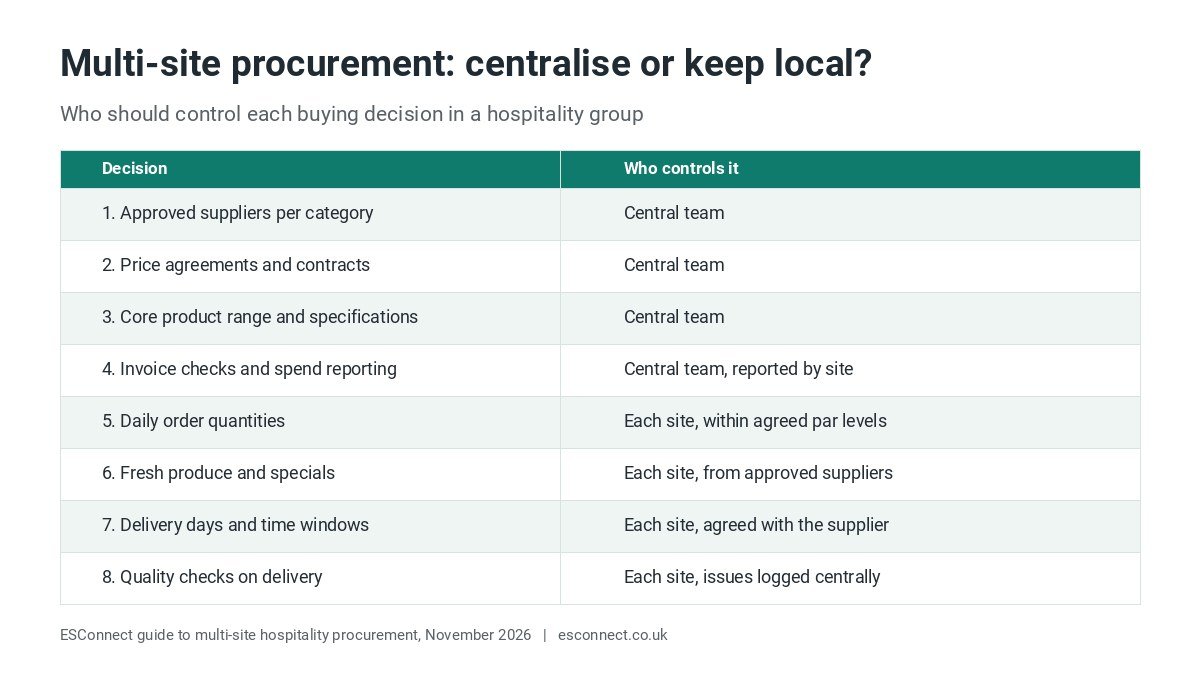
The rule of thumb: if a decision affects price, quality standards or supplier relationships across the group, make it centrally. If it depends on what is happening at one site today, leave it with that site, within agreed limits.
How to Consolidate Supplier Invoices Across Sites
Many groups want fewer suppliers and fewer invoices. There are three common ways to get there:
- Use a broadline supplier for more categories. One foodservice wholesaler covering dry, chilled and frozen goods can replace several smaller suppliers.
- Ask for consolidated statements. Many suppliers can provide one statement per month across all sites, which simplifies payment and checking.
- Bring invoices into one system. An e-procurement platform can collect invoices from every supplier and site in one place, even when suppliers stay separate.
Consolidation has limits. Specialist suppliers often beat broadline wholesalers on fresh fish, meat and produce, and relying on a single supplier for everything increases risk. Consolidate where quality is comparable, and keep specialists where it is not.
Procurement for Restaurant Chains vs Hotel Groups
Restaurant chains usually prioritise menu consistency. Identical specifications, high-volume core lines and tight control of food cost matter most, and some chains add a central production kitchen to control quality further.
Hotel groups buy across many departments: restaurants and bars, breakfast, room service, housekeeping amenities, cleaning supplies and maintenance. Properties may also run different brands or formats, so the approved list often has a shared core plus brand-specific ranges.
Multi-Site Procurement KPIs to Track
A short monthly report by site should cover:
- percentage of spend with approved suppliers
- price variance against agreed prices
- food cost percentage, or spend per cover or per occupied room
- invoice errors found and credits recovered
- delivery accuracy and supplier fill rate
- food waste by site
Our guide to procurement KPIs for hospitality explains how to calculate each one.
Common Multi-Site Procurement Mistakes
- Centralising everything. Sites that cannot buy fresh produce or react to demand will work around the system.
- Keeping too many suppliers just in case. Every extra supplier dilutes your volume and adds admin.
- Negotiating on unit price alone. Delivery charges, minimum orders and price review terms often matter just as much.
- Never checking compliance. Group deals only save money if sites actually use them.
- Skipping manager training. Site teams need to understand the order guide and why it matters.
- Ignoring local delivery realities. A supplier that serves central London well may not reach a site in the countryside on the days you need.
How ESConnect Helps Multi-Site Hospitality Businesses
ESConnect is a London-based hospitality procurement company at New Covent Garden Market. We help UK restaurant groups, hotel groups and multi-site caterers build a clear spend baseline, choose approved suppliers, negotiate group terms and set up ordering processes that site teams will actually follow.
You can find out more about our hospitality procurement services, restaurant procurement services, hotel procurement services and e-procurement support, or contact our team to talk through your sites and suppliers.
Frequently Asked Questions
1. How can I optimise hospitality procurement for multiple locations?
Centralise supplier choice, pricing and product specifications, give each site a standard order guide with agreed par levels, check invoices against agreed prices and review spend by site every month.
2. Should multi-site restaurants use one supplier for everything?
Rarely. One broadline supplier can cover many categories well, but specialists often deliver better quality on fresh fish, meat and produce. A main supplier plus a few specialists, each with a backup, is usually the best balance of price, quality and risk.
3. How do restaurant groups consolidate invoices from many suppliers?
By moving more categories to fewer suppliers, asking for consolidated monthly statements, and using an e-procurement system that collects and checks invoices from every site in one place.
4. What is the best procurement setup for a growing restaurant chain?
Start with a core product list, one main and one backup supplier per category, group pricing agreements and a simple ordering process. Add central invoice checking and monthly reporting by site as you grow.
5. How often should multi-site procurement be reviewed?
Review spend and supplier performance monthly, prices for key lines at least quarterly, and the supplier list as a whole every year or whenever the menu or the number of sites changes.