
Food waste legislation in England now requires every workplace, including restaurants, pubs, cafés and hotels, to keep food waste apart from other rubbish and have it collected for recycling, however little you produce. Firms employing 10 or more full-time-equivalent staff have had to comply since 31 March 2025. Micro-firms have until 31 March 2027.
Wales, Scotland and Northern Ireland run their own rules, with a 5 kg a week threshold and bans on putting food waste into the sewer.
The law is not only a bin problem. WRAP’s July 2025 key facts value the edible food thrown away by UK hospitality and food service at £3.21 billion a year (2021 data). Every kilo you separate is food you already paid a supplier for.
That is why good supply chain management matters here: it shrinks the bin before it reaches the kerb. In this guide, we explain who must comply, what to separate, how the four UK nations differ, the penalties, the paperwork, and the buying decisions that cut the cost of compliance.
Jump to a section:
- What is food waste legislation?
- Who must comply, and when
- What to separate under Simpler Recycling
- Scotland, Wales and Northern Ireland
- Penalties
- Paperwork
- How to comply, step by step
- A 90-cover restaurant example
- Buying decisions that shrink the bin
- Collection contract checks
- Common mistakes
- Checklist
- FAQs
What Is Food Waste Legislation?
Food waste legislation is the set of UK laws that makes businesses separate food waste from general waste, send it for recycling or composting, and keep it out of the drains. In England, the rules sit in sections 45A to 45AZG of the Environmental Protection Act 1990, inserted by the Environment Act 2021, plus two sets of regulations.
- SI 2024/666, the Separation of Waste (England) Regulations 2024: sets out the recyclable waste streams.
- SI 2025/140, the Separation of Waste (England) Regulations 2025: in force from 31 March 2025, with the micro-firm exemption and the co-collection rules.
“Simpler Recycling” is the government’s policy name for these rules, not a legal title. So when a supplier talks about Simpler Recycling, they mean the same food waste legislation.
For a restaurant or pub, the key part is section 45AZB of the 1990 Act. It covers commercial waste that is similar to household waste, which is exactly what a kitchen, bar and dining room produce: plate scrapings, cans, bottles, delivery boxes and film.
The person who presents the waste for collection must present it separated, so the duty sits with your business, not only with your collector.
Who Must Comply With Food Waste Legislation, and When?
In England, food waste legislation applies to all businesses, charities and public sector workplaces. GOV.UK names cafés, restaurants, pubs, takeaways and hotels directly, and the duty covers waste from staff, customers and visitors.
| Business size (England) | Food waste legislation deadline |
|---|---|
| Staff of 10 or more (full-time equivalent) | 31 March 2025 (already in force) |
| Under 10 full-time-equivalent employees (micro-firm) | 31 March 2027 |
| All workplaces: plastic film added to the plastic stream | 31 March 2027 |
How Do You Count Full-Time-Equivalent Staff?
You count staff across the whole business, not per site. GOV.UK’s own example is a firm with 5 employees at each of 3 sites. That adds up to 15, so it is not a micro-firm.
Part-timers count pro rata, based on their average weekly hours over the previous 12 weeks against full-time contracted hours. Volunteers, contractors and the self-employed do not count. You do not need to register for the micro-firm exemption.
Does a Small Amount of Food Waste Still Count?
Not in England. English food waste legislation applies however little food waste you have, even if the workplace has no kitchen. A wet-led pub that only bins lemon ends and staff lunch scraps still needs a food waste collection.
The 5 kg a week threshold you may have read about applies in Wales, Scotland and Northern Ireland, not England.
What Must You Separate Under Simpler Recycling?
Under Simpler Recycling, an English workplace must keep four groups apart: food waste, paper and card, dry recyclables, and residual waste. This is why people call it the “4 bin rule”.
- Food waste: plate scrapings, prep trim, spoiled stock and coffee grounds.
- Paper and card: delivery boxes, cardboard egg trays and paper bags.
- Dry recyclables: glass bottles, cans and plastic tubs, which may share one bin.
- Residual waste: whatever is left.
Two parts of the food waste legislation catch kitchens out. First, paper and card must stay apart from the glass, metal and plastic bin, unless your collector has completed a written co-collection assessment. Second, food waste can never be mixed with any dry recyclable.
From 31 March 2027, plastic film and plastic bags join the plastic stream. Think of the film around veg boxes and the shrink-wrap on a pallet delivery.
Cooking oil needs its own plan. The GOV.UK Simpler Recycling guidance says small amounts can go in the food bin, larger amounts need a used cooking oil collection, and oil must never go down the drain.
A longer-life frying oil that cuts waste means fewer drums to fill and collect.
How Does Food Waste Legislation Differ in Scotland, Wales and Northern Ireland?
Food waste legislation is devolved, so a group with sites in more than one nation works to more than one rulebook. Wales, Scotland and Northern Ireland all use a 5 kg a week threshold and all ban food waste from the sewer (Scotland outside rural areas).
| Nation | Main law | Who must separate food waste | Food waste to sewer |
|---|---|---|---|
| England | Separation of Waste (England) Regulations 2024 and 2025 | All workplaces, any amount (micro-firms by 31 March 2027) | No specific ban, but never put oil, fat or solids down drains |
| Wales | Waste Separation Requirements (Wales) Regulations 2023 | Workplaces producing 5 kg or more a week, since 6 April 2024 | Banned in any amount, including macerators |
| Scotland | Waste (Scotland) Regulations 2012 | Food businesses producing 5 kg or more a week, since 1 January 2016 (rural postcodes exempt) | Banned outside rural areas |
| Northern Ireland | Food Waste Regulations (Northern Ireland) 2015 | Food businesses producing 5 kg or more a week, since 1 April 2017 | Banned, with no rural exemption |
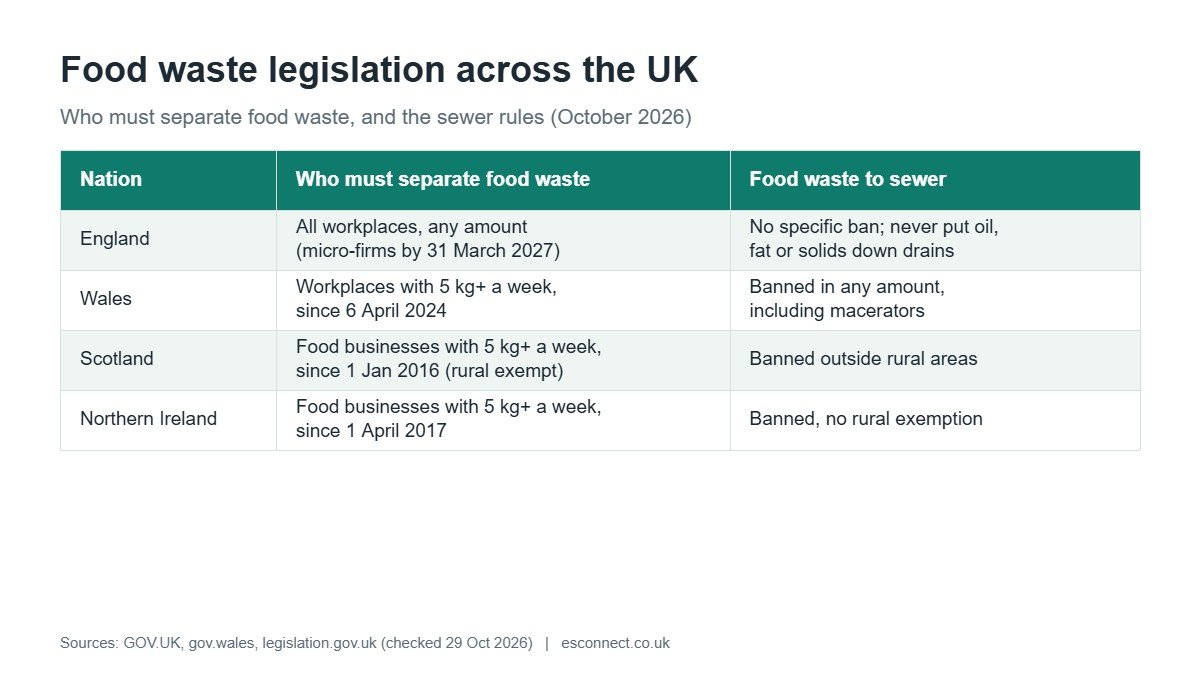
Wales has the strictest food waste legislation. The Welsh Government’s workplace recycling guidance also requires separate glass, small electricals and unsold textiles, and it treats macerators and enzyme digesters as sending food to the sewer.
Scotland’s rural exemption is set by postcode, so check yours before you rely on it. In Northern Ireland, a draft waste strategy proposes reviewing the rules by the end of 2027, with a view to covering all businesses.
What Are the Penalties for Breaking the Rules?
Penalties under food waste legislation depend on where your site is. In England, the Environment Agency regulates Simpler Recycling. It starts with a compliance notice that sets out what you must fix and by when, and ignoring that notice is a criminal offence punishable by a court fine.
On contamination, the Agency promises a “pragmatic and proportionate” line. Anyone can report a business that is not separating its waste.
- Wales: a £300 fixed penalty for an occupier who fails to separate, and £300 for putting food waste into the sewer. Paying 50% within 28 days settles it.
- Scotland: SEPA and local councils enforce, with fines on conviction.
- Northern Ireland: breaking the separation or sewer duty is an offence, with fines on conviction.
- England and Wales: a £300 fixed penalty if you cannot produce your waste paperwork when asked.
The day-to-day risk is often more practical. A collector can refuse a contaminated food bin, and then it sits by your back door until the next lift.
What Paperwork Does Food Waste Legislation Require?
Food waste legislation sits on top of the waste duty of care that every business already has. You must hand waste only to an authorised collector, describe it in writing, and keep the waste transfer notes for at least two years in all four UK nations.
Most kitchens use an annual “season ticket”, which is one transfer note covering repeat collections for up to a year. Put its renewal date in the diary. An expired note is the easiest failure an inspector can find.
Digital waste tracking is arriving too. Sites that receive waste in England and Wales have had to report on the government service since 1 October 2026, and carriers, brokers and dealers follow from October 2027. Hospitality businesses are not named in either phase yet.
How to Comply With Food Waste Legislation: Step by Step
Most venues can meet food waste legislation within a few weeks. The steps below work for a single site and scale to a group.
Step 1: Audit What You Throw Away
Weigh the food bin every night for a week before the last lift. Split the total into spoilage, prep waste and plate waste, because each one has a different fix.
Step 2: Get Quotes for Separate Collections
Ask two or three collectors to price food waste, paper and card, mixed dry recyclables and residual waste. Compare them on the contract points further down, not on the price per lift alone.
Step 3: Put the Right Bins in the Right Places
Place a lidded food caddy at each section, at the pass and at the pot wash. Add matching bins front of house and in the staff room, because food waste legislation covers waste from customers and staff as well as the kitchen.
Use colour codes and picture signs. A new kitchen porter on their first shift will follow a picture faster than a paragraph.
Step 4: Train the Team
Brief the team in five minutes at pre-service line-up, then add the bin rules to every induction. Give one named person, often the KP or a section chef, ownership of emptying and cleaning caddies.
Step 5: Keep the Paperwork Tidy
File the transfer note, any co-collection assessment and your collector’s registration details in one place.
Step 6: Measure and Reduce
Track food waste in kg per cover each month and review it with your other procurement KPIs. A rising number is your early warning that ordering has drifted.
Food Waste Legislation Example: A 90-Cover Restaurant
The real cost of food waste legislation is rarely the bin. It is the food inside it. Here is a worked example using WRAP’s cost figures for restaurants.
Suppose your 90-cover restaurant weighs its food bin for a month and averages 150 kg a week. Your collector quotes £14 per lift for a 240-litre food bin, emptied twice a week. These are illustrative figures, so use your own quotes.
Annual food waste = 150 kg × 52 weeks = 7,800 kg (7.8 tonnes)
Collection cost = 2 lifts × 52 weeks × £14 = £1,456 a year
WRAP’s study of hospitality food waste put the cost of total food waste in restaurants at £3,447 per tonne, counting the food, the staff time spent on it and disposal (2011 prices). At that rate, 7.8 tonnes costs about £26,887 a year.
| Item | Annual figure |
|---|---|
| Food waste collected | 7.8 tonnes |
| Collection charges (2 lifts a week at £14) | £1,456 |
| Cost of that food waste at WRAP’s restaurant rate (£3,447 per tonne) | £26,887 |
| Saving from a 20% cut in food waste (1.56 tonnes) | £5,377 |
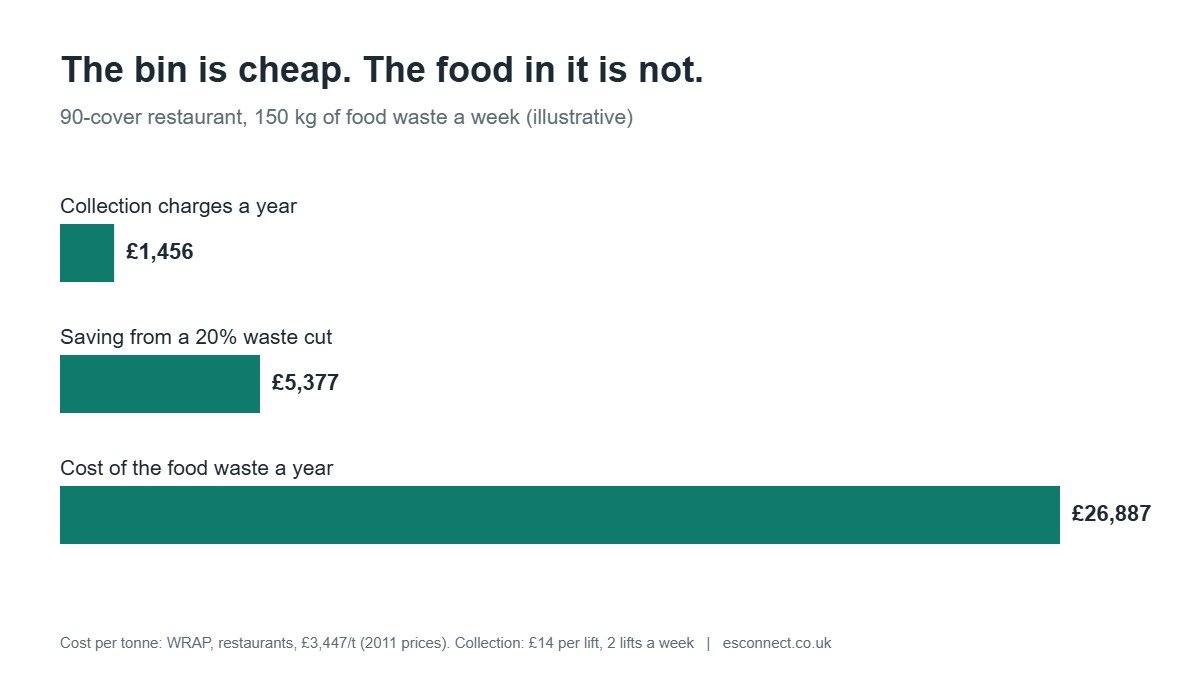
So the collection charge is about 5% of the total. Cut the waste by 20% and you save around £5,377 a year, which is more than three years of collection charges.
WRAP’s per-tonne figures date from 2011, and food prices have risen since. Your real cost per tonne is likely higher. To cost your own dishes, use our guide on how to calculate food cost.
How Do Buying Decisions Shrink the Food Waste Bin?
The cheapest way to meet food waste legislation is to produce less food waste. Most of what lands in the caddy was decided days earlier, when the order went in.
- Order to par: set stock levels from real covers, not habit.
- Match pack size to usage: if an opened 2 kg tub of crème fraîche lasts five days and you use 600 g a week, buy the smaller tub.
- Set delivery days around shelf life: take fish and salad in smaller, more frequent drops, and agree minimum order values so small drops do not attract fees.
- Write shelf life into the spec: state a minimum remaining life on delivery, for example seven days on dairy.
- Check at goods-in: reject short-dated or warm chilled deliveries (the legal maximum for chilled food in England is 8°C, and most kitchens target 5°C), then log the credit note.
- Rotate stock: first in, first out, with clear dates on every container.
Setting accurate par levels is the single biggest lever on spoilage.
Good restaurant inventory management then keeps those levels honest between stocktakes.
Fresh produce is where most spoilage starts, so smarter fruit and veg procurement pays back quickly.
With supply chain challenges pushing up delivery charges and minimum orders, plan drop frequency and waste together, not one at a time.
For the kitchen side, see our five ways to reduce food waste.
And for front-line habits, these practical tips to cut restaurant food waste are a good team briefing.
What Should a Commercial Food Waste Collection Contract Include?
A commercial food waste contract is usually a small spend, so few operators read it closely. These clauses decide what food waste legislation really costs you.
- Price per lift and bin size: 140-litre or 240-litre bins, plus any caddy or liner charges.
- Frequency: weekly at the very least for a kitchen, and more often in summer to keep flies and smells down.
- Contamination rules: what counts as contaminated, and the charge for a rejected lift.
- Liners: whether compostable liners are accepted.
- Weight data: kg per lift on a monthly report, so you can track waste without your own scale.
- Paperwork: the annual transfer note and a copy of any co-collection assessment.
- Term and exit: contract length, auto-renewal and notice period.
If you already buy through a sustainable procurement policy, add your waste collector to the same annual supplier review.
Common Food Waste Legislation Mistakes
Most food waste legislation problems come from a handful of assumptions. These are the most common in UK kitchens.
Counting Staff Per Site
A group with four small cafés is not four micro-firms. Staff are counted across the business, so the 2027 exemption may not apply to you at all.
Assuming a Drinks-Led Pub Is Exempt
In England, food waste legislation sets no minimum amount. Garnish fruit, bar snacks and staff meals all count, so a wet-led pub still needs a food waste stream.
Using a Macerator or the Drain
GOV.UK says you must arrange food waste collection however little you produce, so a macerator cannot replace the caddy in England. In Wales, Scotland and Northern Ireland, food waste to sewer is banned outright.
Letting Packaging Into the Food Bin
Gloves, film and portion pots are the usual culprits. One contaminated lift can cost you a rejection charge and a smelly week.
Letting the Transfer Note Expire
Season tickets last up to a year. If yours lapsed when you changed collector, you have a paperwork gap from that day.
Food Waste Legislation Checklist: 7 Rules for Your Venue
Use this food waste legislation checklist at your next managers’ meeting.
- Count full-time-equivalent staff across all sites to confirm your deadline.
- Arrange separate collections for food, paper and card, dry recyclables and residual waste.
- Put labelled food caddies in the kitchen, front of house and the staff room.
- Keep oil, fat and food out of every drain and sink.
- Hold a current transfer note or season ticket and keep notes for two years.
- Train every new starter on the bins in their first shift.
- Measure kg of food waste per cover monthly and act on rises.
Final Thoughts
Food waste legislation is now a fixed cost of running a UK hospitality business. If you have 10 or more full-time-equivalent staff in England, you should already comply. If you are a micro-firm, 31 March 2027 is your date.
The smart move is to treat food waste legislation as a measurement tool. Once food waste sits in its own bin, you can weigh it, cost it and cut it at the ordering stage.
At ESConnect, our hospitality procurement team helps operators set pars, specs and delivery days that keep good food out of the caddy.
If your food bin is filling faster than your covers are growing, talk to our team about a review of your ordering and supplier set-up.
Frequently Asked Questions
1. Is food waste legislation the same as Simpler Recycling?
In England, yes. Simpler Recycling is the government’s name for the workplace recycling rules in the Environmental Protection Act 1990 and the Separation of Waste (England) Regulations. Food waste is one of the streams those rules cover, alongside paper and card, dry recyclables and residual waste.
2. What is the 4 bin rule for businesses?
It is the informal name for Simpler Recycling’s four groups: food waste, paper and card, dry recyclables (glass, metal and plastic) and residual waste. Glass, metal and plastic may share a bin. Paper and card stay separate unless your collector has done a written co-collection assessment.
3. Does food waste legislation apply to pubs that only serve drinks?
In England, yes, because there is no minimum amount and staff meals count. Wales applies the rule only if you produce 5 kg or more a week. Northern Ireland’s official guidance says the rules do not cover preparing and selling drinks, so a drinks-only pub may fall outside them.
4. Can staff take leftover food home instead?
GOV.UK is clear that you “should not ask members of staff to take food waste home”. Letting staff eat or take genuine surplus is a separate matter, but it cannot replace the separate food waste collection your business must arrange.
5. Does food waste legislation make me report how much food I waste?
No. The government consulted on mandatory food waste reporting for large food businesses in England in 2022, then withdrew its response in November 2023 and said it would reconsider. As of October 2026, reporting is voluntary, though weighing your waste is still good practice.
6. Who is responsible if the landlord manages the bins?
The Environment Agency can serve a compliance notice on whoever presents the waste for collection, including a landlord or facilities management company. Agree in writing who arranges each stream, and keep a copy of their transfer note with your own records.
7. What happens to commercial food waste after collection?
Collectors must send separated food waste for recycling or composting. In practice, commercial food waste often goes to anaerobic digestion, which turns it into biogas and a fertiliser, or to composting. Ask your collector where it goes, as the answer helps your sustainability reporting.
8. Can I donate surplus food instead of binning it?
Yes. Redistributing safe, in-date surplus to charities or staff is better than recycling it, and it reduces what goes in the caddy. You still need a food waste collection for the rest, such as plate waste and prep trim.
9. Will food waste legislation change again in 2027?
Yes, in several ways. Micro-firms in England must comply by 31 March 2027, when plastic film also joins the plastic stream. Digital waste tracking extends to waste carriers from October 2027, and a draft Northern Ireland strategy proposes reviewing its food waste rules by the end of 2027.
10. What alternatives to general waste disposal can reduce surplus food and food waste?
Prevention comes first: order and prepare less. After that, redistribute safe surplus to charities or surplus food apps, and send unavoidable waste for separate collection, where it can be processed by anaerobic digestion or composting. In the UK, catering waste must never be fed to farm animals.
11. What is the commercial food waste collection law in the UK for 2027?
In England, micro-businesses with fewer than 10 full-time equivalent employees must separate food waste for collection from 31 March 2027. Larger businesses have had to do so since 31 March 2025, and Wales has required separation for all workplaces since April 2024.