
Par levels are the minimum amount of each stock item a kitchen, bar or hotel should hold between deliveries, so you never run out and never over-order. Set them well and you cut both waste and stockouts.
Many UK kitchens still order on gut feel. The chef checks the walk-in, guesses what the weekend needs and adds a bit extra “just in case”. That extra stock ties up cash and fridge space, and some of it ends up in the bin.
In this guide, we explain how par levels work, the par level formula, a worked UK gastropub example, how delivery days and use-by dates change your numbers, and a checklist you can use this week.
Par levels are a core part of supply chain management in hospitality, because they link what you sell to what you buy.
In this guide:
- What are par levels?
- Why they matter in 2026
- The par level formula
- How to calculate par levels
- A worked par sheet
- Delivery days and par
- Chilled food limits
- Christmas and bank holidays
- Bar and housekeeping
- Minimum order values
- Common mistakes
- How procurement helps
- Checklist
- FAQs
What Are Par Levels?
Par levels are target stock quantities for each item you buy. They tell you how much should be on the shelf after a delivery arrives, based on how fast you use the item and how long until the next drop.
When stock falls below par, you order. The order quantity is simply the gap:
Order quantity = par level − stock on hand
For example, if your par for double cream is 11 litres and the fridge holds 4 litres, you order 7 litres.
A par is not the same as a reorder point. The reorder point is the trigger that tells you when to order. The par level is the amount you top back up to. Many kitchens use both: they count stock against the reorder point, then order back up to par.
They also differ from minimum order values, which are your supplier’s rule, not yours. We explain how the two interact in the minimum order values section.
Why Do Par Levels Matter for UK Hospitality in 2026?
Waste and stockouts both cost real money. WRAP’s report on the hospitality and food service sector (2013) put the cost of food waste at about £2.5 billion a year in 2013 prices. That worked out at roughly £10,000 per outlet.
The supply side is getting harder too. In May 2026, Lynx Purchasing reported that some suppliers had added delivery charges or fuel surcharges, reduced their delivery days and raised the minimum spend per order.
Fewer deliveries mean longer gaps to cover. So stock targets set for last year’s delivery pattern may now be too low, and the first sign will be a dish coming off the menu on a Saturday night.
Well-set pars also free up cash. Every kilo sitting in the walk-in beyond what you need is money you have already paid for and cannot use elsewhere.
If you want the wider picture on stock control, our guide to restaurant inventory management covers counts, storage and stock records.
What Is the Par Level Formula?
The most practical formula for hospitality is:
Par level = (average daily usage × days until next delivery) + safety stock
Average daily usage comes from your sales or stock records. Days until next delivery is the longest gap in your delivery week, not the average. Safety stock is the buffer for busy days, late lorries and short deliveries.
Some software vendors divide total usage by the number of deliveries instead. That gives similar answers when deliveries are evenly spaced. It goes wrong when they are not, for example a Friday drop that has to last until Monday.
For safety stock, a good starting point is 20-25% of the usage you expect between deliveries. Raise it for items with unreliable supply. Lower it for items with a short shelf life.
Always round up to the pack size you actually buy. If potatoes come in 25kg sacks, a par of 48kg becomes 50kg.
How to Calculate Par Levels: Step by Step
You can set pars for your main lines in a few hours. Start with your top 30 lines by spend, because they carry most of the cash and most of the risk.
Step 1: Pull four weeks of usage
Use stocktake figures or supplier invoices to find how much of each item you used. Divide by the number of trading days. Leave out unusual weeks, such as a private event.
Step 2: Map your delivery days
Write down when each supplier delivers and its order cut-off time. Find the longest gap for each one. A Monday, Wednesday and Friday meat delivery has a three-day gap from Friday to Monday. Count stock before the cut-off, or your next possible delivery moves back a day.
Step 3: Work out cycle usage
Multiply average daily usage by the longest gap in days. This is what you need to get from one delivery to the next on a normal week.
Step 4: Add safety stock
Add 20-25% of the cycle usage. For a supplier with a poor delivery record, go higher. Our guide to building a hospitality supplier scorecard shows how to measure that record.
Step 5: Check the shelf-life ceiling
Make sure the par does not exceed what you can use before the use-by date. We explain this limit below.
Step 6: Round to pack sizes and write the par sheet
Round each figure up to the case, sack or keg you buy. Then put the figures on a sheet next to each storage area, so whoever does the count can order without guessing.
A Worked Example: Gastropub Par Levels for Five Lines
Here are the pars worked out for five lines at an 80-cover gastropub. The prices are illustrative October 2026 figures, so swap in your own price file.
| Item | Daily use | Delivery days | Longest gap | Cycle use + 20% | Par (pack size) | Unit price | Cash at par |
|---|---|---|---|---|---|---|---|
| Chicken breast | 6kg | Mon, Wed, Fri | 3 days | 21.6kg | 22kg | £6.50/kg | £143.00 |
| Double cream | 3 litres | Tue, Thu, Sat | 3 days | 10.8 litres | 11 litres | £3.20/litre | £35.20 |
| Potatoes | 20kg | Mon to Sat | 2 days | 48kg | 50kg (2 sacks) | £0.95/kg | £47.50 |
| Lager (11-gallon kegs) | 43 pints | Weekly | 7 days | 4.1 kegs | 5 kegs | £135/keg | £675.00 |
| Fryer oil (20-litre drums) | 0.21 drums | Weekly | 7 days | 1.8 drums | 2 drums | £32/drum | £64.00 |
| Total | £964.70 |
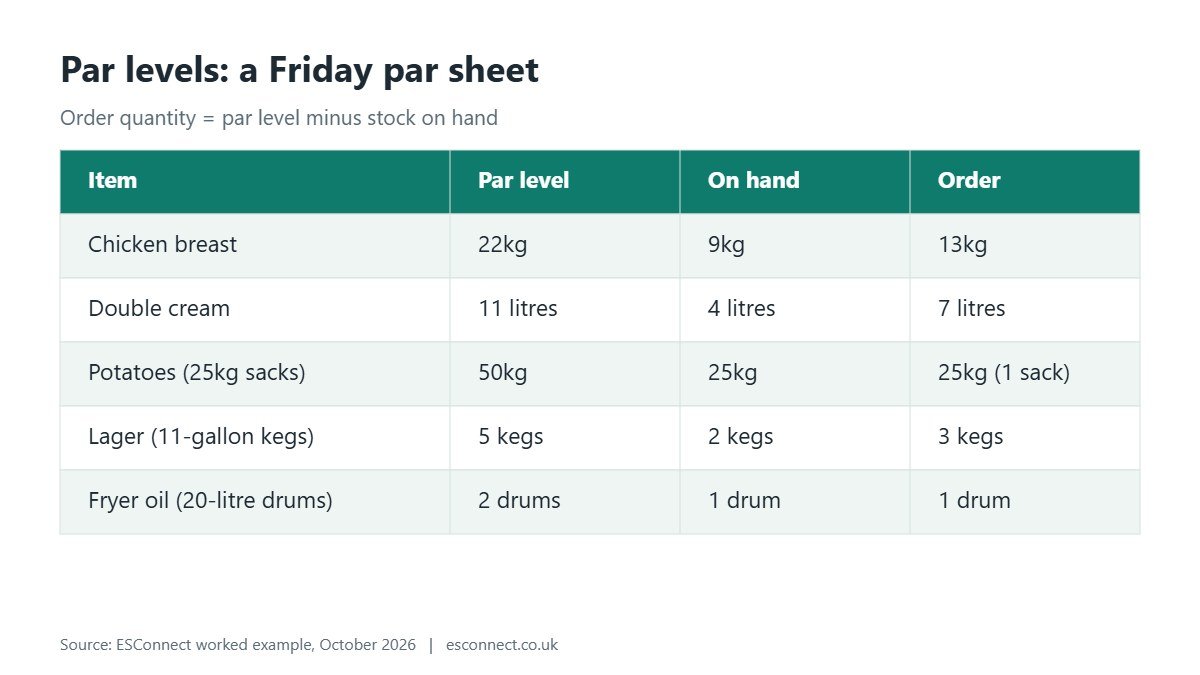
On a Friday count, the kitchen finds 9kg of chicken, 4 litres of cream and 25kg of potatoes. It also counts 2 kegs of lager and 1 drum of fryer oil. So the orders are 13kg of chicken, 7 litres of cream, one 25kg sack of potatoes, 3 kegs and 1 drum.
The cash column matters. Holding these five lines at par ties up £964.70. If the same kitchen stocked “a bit extra” of everything, that figure would rise without selling a single extra plate.
Knowing the value of your stock at par also helps your food cost work. Our guide on how to calculate food cost in a restaurant shows how stock values feed into your monthly figures.
How Do Delivery Days Change Your Par Levels?
Delivery days change par levels more than any other factor, yet kitchens rarely revisit them. When the gap between deliveries grows, the par has to grow with it.
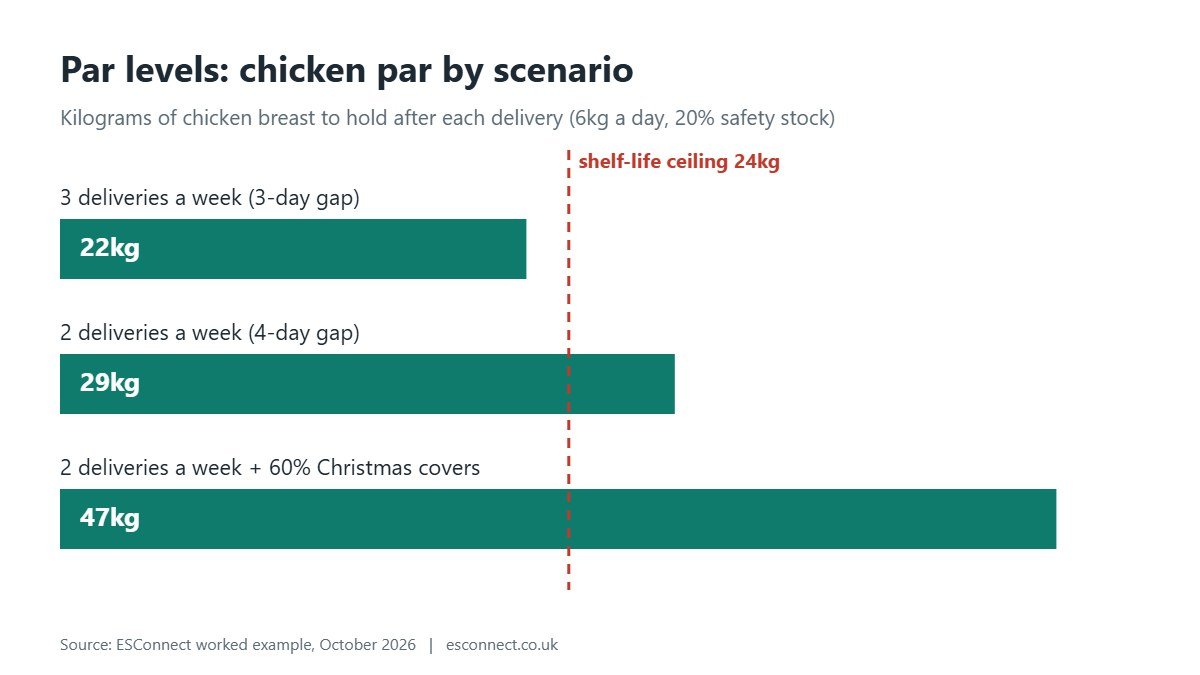
Take the chicken line above. With three meat deliveries a week, the longest gap is three days and the par is 22kg. If the supplier drops to two deliveries, Monday and Thursday, the longest gap becomes four days.
The new par is 6kg × 4 days = 24kg, plus 20% safety stock, which rounds to 29kg. That is 7kg more chicken on the shelf at any one time.
Delivery changes also bring new costs. Fewer drops often come with higher minimum order values or drop charges, so check how fuel and delivery costs affect your procurement before you agree to a new schedule.
Sometimes the better answer is a different supplier mix. If one wholesaler can deliver daily and another only twice a week, move your fast, perishable lines to the daily one.
What Limits Par Levels for Chilled Food?
A par level is useless if the stock goes out of date before you use it. So every chilled line needs a shelf-life ceiling:
Maximum par = daily usage × usable days left at delivery
If chicken arrives with four usable days left and you use 6kg a day, you cannot hold more than 24kg, however long the delivery gap. So the 22kg par from our three-delivery week works, but the 29kg par for a two-delivery week does not. You would need to freeze a portion on arrival, keep three deliveries a week or buy some lines frozen.
Temperature matters as well. The FSA’s chilling guidance says cold food must be kept at 8°C or below, a legal requirement in England, Wales and Northern Ireland, and recommends setting fridges at 5°C or below. Scotland has its own chill-holding rules, so check Food Standards Scotland guidance if you trade there.
Over-stocked fridges struggle to hold that temperature, so high stock targets can become a food safety problem, not just a waste problem. Rotate stock with first in, first out (FIFO), or first expiry, first out (FEFO) for items with mixed dates.
For dairy, fruit and vegetables, ask suppliers how many days of life a product will have when it reaches you. Good dairy suppliers and fruit and veg wholesalers will tell you this upfront.
How to Adjust Par Levels for Christmas and Bank Holidays
Pars are working figures, not fixed numbers. Change them whenever demand or delivery patterns shift.
For busy periods, use your bookings to create a demand multiplier. If covers for the week of 14 December are 60% higher than a normal week, multiply daily usage by 1.6 for the lines on your festive menu.
In our chicken example, a 60% uplift with two deliveries a week gives 9.6kg a day × 4 days, plus 20%, which rounds up to 47kg. That is well above the 24kg shelf-life ceiling, so most of it would need to be frozen on arrival, or the supplier would need to deliver more often that week.
UK bank holidays need a second adjustment. Many suppliers do not deliver on Christmas Day, Boxing Day, New Year’s Day or other bank holidays, so the gap to the next delivery grows by a day or more. Add those days to the calculation for the week in question.
Festive menus are easier to plan when costed early. Our guide to Christmas menu costing shows how pre-orders can feed directly into your pars and purchase orders.
Par Levels Behind the Bar and in Housekeeping
The same formula works outside the kitchen. Only the units change.
Kegs, bottles and cases
Bar par levels work in pints, bottles and cases. Draught beer comes in kegs, so think in pints. An 11-gallon keg holds 88 pints. If you sell 300 pints of a lager a week and the brewery delivers weekly, cycle usage is about 3.4 kegs. Add 20% and round up, and your par is 5 kegs. In practice you pour slightly fewer than 88 pints, because of line cleaning and fobbing, which is another reason for the buffer.
For spirits and wine, set pars by bottle for the back bar and by case for the cellar. Count the open bottles as part bottles, or your figures will drift upwards.
Linen and amenities
Housekeeping par levels follow the same logic. Hotels often use the “3-par” rule for linen: one set on the bed, one in the laundry and one on the shelf. A hotel with 50 beds therefore needs 150 sets of sheets at 3 par. Hotels using an off-site laundry with a longer turnaround often move to 4 or 5 par.
Guest amenities work like food. Multiply use per occupied room by forecast occupancy and the days until the next delivery, then add a buffer.
How Do Minimum Order Values Affect Par Levels?
A minimum order value (MOV) is the smallest order a supplier will deliver without a charge. When your par levels produce an order below the MOV, you have three options.
- Combine lines from the same supplier. Add other items you need from that supplier to the same delivery, so the total clears the minimum.
- Top up long-life lines only. If you must add value, raise par levels slightly on dry goods, tins or frozen stock, never on short-life chilled items.
- Move small lines elsewhere. If one supplier’s minimum is regularly above what you need, buy those lines from a supplier with a lower MOV or more frequent drops.
For example, if a dairy supplier’s minimum is £150 and your cream and butter order comes to £60, add cheese and longer-life dairy you would buy anyway. Do not add extra fresh cream just to hit the number.
Common Mistakes With Par Levels
These five errors are common causes of waste and stockouts in UK kitchens and bars.
Setting par levels once and never reviewing them
Menus, covers and delivery days change through the year. A figure set in March may be wrong by July. Review your top lines at least monthly, and every time a supplier changes its schedule.
Using the average delivery gap
The average gap hides the weekend. If your longest gap is Friday to Monday, that is the gap your pars must cover, or Sunday service runs short.
Ignoring shelf life
A par that suits the delivery gap but exceeds the use-by window guarantees waste. Always check the shelf-life ceiling for chilled and fresh lines.
Not rounding to pack sizes
Par levels of 11.3 litres are not an order anyone can place. Round to the pack you buy, and note the pack size on the par sheet so nobody has to work it out.
Leaving the count to whoever is free
The system only works if the count is accurate. Give one person per section the job, at the same time each day, and use the same sheet every time.
Many of these problems show up first as gaps on the menu. Our guide to preventing stockouts covers the other causes.
How Procurement Supports Better Par Levels
Par levels work best when your suppliers, delivery days and purchase orders are set up around them. That is a procurement job as much as a kitchen one.
A clear purchase order process stops people ordering outside the par sheet. Our guide to purchase order control explains how approvals and order limits keep spending in line.
Digital ordering helps too. With e-procurement, pars can sit inside the ordering system, so the suggested order is simply par minus the latest count.
At ESConnect, we help UK hotels, restaurants and pubs set up supplier schedules, ordering processes and stock targets that fit how they actually trade.
Par Levels Checklist
- Start with your top 30 lines by spend.
- Use four weeks of real usage, not guesses.
- Map every supplier’s delivery days and find the longest gap.
- Apply the formula: (daily usage × longest gap) + 20-25% safety stock.
- Check each chilled line against its shelf-life ceiling.
- Round up to the pack size you buy.
- Put the par sheet beside each storage area.
- Order the gap: par minus stock on hand.
- Raise pars for busy weeks and bank holidays, using bookings.
- Review the top lines monthly and whenever delivery days change.
Final Thoughts
A good par sheet turns ordering from guesswork into a simple sum: what you use, how long until the next delivery and a sensible buffer.
The right numbers depend on your own delivery days, shelf lives and busy weeks. Build your par levels from your own data and review them often.
If you want help matching suppliers and delivery schedules to your par levels, get in touch with the ESConnect team. Send us your current par sheet and delivery days, and we will show you where stock and cash are being lost.
Frequently Asked Questions
1. What are par levels in a restaurant?
Par levels in a restaurant are the target quantities of each ingredient or product the kitchen should hold between deliveries. They are based on how fast the item is used and how long until the next delivery, plus a safety buffer, so the kitchen avoids both waste and running out.
2. How do you calculate par levels?
Multiply average daily usage by the number of days until your next delivery, then add safety stock of around 20-25%. For example, 6kg of chicken a day with a three-day gap gives 18kg, plus 3.6kg of safety stock, so the par is 22kg once rounded.
3. What is the difference between par stock and par levels?
The terms are used in the same way in most UK kitchens and hotels. Both describe the target amount of stock to hold between deliveries. Some hotels use “par stock” mainly for linen and amenities, while kitchens tend to say “par levels”.
4. How often should par levels be reviewed?
Review par levels for your top lines at least monthly, and straight away when a supplier changes delivery days, a new menu launches or covers change sharply. Seasonal peaks such as Christmas need a separate, temporary set of figures.
5. What is a good safety stock for a kitchen?
A starting point is 20-25% of the usage expected between deliveries. Increase it for items with unreliable supply or long lead times. Reduce it for fresh items with a short shelf life, where extra stock is more likely to be wasted than used.
6. Should I use a par level template or software?
A simple spreadsheet par sheet works well for a single site with a stable menu. Multi-site groups usually benefit from ordering software, where par levels sit in the system and suggested orders are created automatically from each stock count.
7. How do par levels reduce food waste?
Par levels stop over-ordering by limiting each order to the gap between stock on hand and the target. Combined with a shelf-life ceiling and FIFO rotation, they keep less stock sitting in fridges past its best.
8. Do par levels work for bars?
Yes. Bars set par levels by keg, bottle or case. An 11-gallon keg holds 88 pints, so weekly pint sales divided by 88 gives the number of kegs used between weekly deliveries, before adding a buffer.
9. What is the 3-par rule in hotels?
The 3-par rule means holding three full sets of linen for every bed: one in use, one in the laundry and one in storage. Hotels with slower off-site laundry often hold 4 or 5 sets per bed instead.
10. Can par levels help with cash flow?
Yes. Par levels show the value of stock you should be holding at any time. Anything above that is cash tied up on shelves. In our gastropub example, five lines at par hold £964.70, which gives a clear benchmark to check against.