
Christmas menu costing is the process of working out exactly what each festive cover costs you, so you can set a price that still makes money in December. You add up every item on the plate, add a waste allowance and divide by the menu price without VAT.
Most UK pubs and restaurants price festive menus in September or October, then serve them in December. After a dry summer that hit potatoes, sprouts and other vegetables, prices can move a long way in that gap.
Good Christmas menu costing protects your margin before the first party books. In this guide, we explain how it works, with a worked £36 example, the VAT trap, a pricing formula, 2026 supply risks and a checklist you can use this week.
If you want help with the buying side, our procurement savings service covers festive price files too.
In this guide:
- What is Christmas menu costing?
- Why it matters in 2026
- How to do it, step by step
- A worked £36 example
- The VAT trap
- How to set your price
- How to cost a choice menu
- Risky ingredients in 2026
- Using pre-orders
- What food GP does not show
- Common mistakes
- How procurement helps
- When to re-cost
- Checklist
- FAQs
What Is Christmas Menu Costing?
Christmas menu costing means calculating the full food cost of one festive cover and comparing it with the price you will charge. It covers every course and every extra, from the turkey to the cracker.
The result is shown as a food cost percentage or a gross profit (GP) percentage:
Food cost % = cost per cover ÷ net selling price × 100
For example, if a cover costs £8.32 to make and you keep £30 after VAT, your food cost is 27.7%. Your GP is 72.3%.
It works in the same way as everyday costing. If you need a refresher, our guide on how to calculate food cost in a restaurant explains the standard formulas. The difference at Christmas is timing. You fix the price months before you buy the stock.
Why Does Christmas Menu Costing Matter in 2026?
Food prices are still rising. The NIQ x Prestige Purchasing Foodservice Price Index reached 154.1 in August 2026. That was up 0.4% on the month and 2.7% on the year.
Some festive lines carry more risk than that average. Lynx Purchasing’s Autumn 2026 forecast (17 September 2026) says the dry summer hurt potato crops and brassicas. It also says sprout planting was late and salmon will stay expensive into Christmas.
At the same time, guests expect a familiar price. The average three-course Christmas meal at UK pub and restaurant chains was £36 in 2025, according to Meaningful Vision data reported by The Morning Advertiser.
So you cannot simply push the price up. Careful Christmas menu costing is how you keep the price competitive and the margin safe.
How Do You Do Christmas Menu Costing? Step by Step
You need three things before you start: written recipes with portion weights, your supplier’s latest price file and your planned menu price.
Step 1: List every component
Write down each item on the plate. Include sauces, garnish, bread and butter, crackers and any petits fours. Small items add up fast across hundreds of covers.
Step 2: Cost each portion
For accurate Christmas menu costing, multiply the portion weight by the unit price from your price file. For example, 260g of turkey crown at £9.80/kg costs £2.55. Use raw weights, not cooked ones.
Step 3: Add a waste allowance
Add 5% for trim, over-production and the odd dropped plate. Busy December services always produce some waste. You can find practical ideas in our guide to ways to reduce food waste.
Step 4: Remove VAT from the menu price
Divide the menu price by 1.2 to find what you actually keep. A £36 menu price gives you £30 after VAT.
Step 5: Stress-test your Christmas menu costing
Raise the cost of high-risk lines and check that your GP still hits target. Most operators skip this step, and it is the one that matters most this year.
Christmas Menu Costing Example: A £36 Three-Course Menu
Here is a full Christmas menu costing worked through for a typical pub or brasserie set menu at a 60-cover site. The unit costs are illustrative October 2026 prices, so replace them with your own price file.
The “December stress” column uses our own assumed rises, graded by the risks Lynx describes. Lynx gives no percentages. We used roughly 48-60% for high-risk lines, 15-21% for medium-risk lines and 2-4% for low-risk lines.
| Plate component | Portion | Unit cost | October cost | Risk | December stress |
|---|---|---|---|---|---|
| Chicken liver parfait, brioche, chutney | 1 starter | recipe | £1.40 | Low | £1.45 |
| Turkey crown | 260g raw | £9.80/kg | £2.55 | Medium | £2.93 |
| Pigs in blankets | 3 pieces | £0.26 each | £0.78 | Low | £0.80 |
| Roast potatoes | 220g raw | £0.95/kg | £0.21 | High | £0.31 |
| Brussels sprouts | 90g | £3.20/kg | £0.29 | High | £0.46 |
| Carrots and parsnips | 120g | £1.60/kg | £0.19 | Medium | £0.23 |
| Stuffing, cranberry, gravy | 1 serving | recipe | £0.45 | Low | £0.46 |
| Christmas pudding, brandy sauce | 1 dessert | recipe | £1.25 | Low | £1.28 |
| Bread and butter | 1 serving | recipe | £0.25 | Low | £0.26 |
| Cracker | 1 | £0.55 | £0.55 | Fixed | £0.55 |
| Subtotal | £7.92 | £8.73 | |||
| Waste allowance (5%) | £0.40 | £0.44 | |||
| Cost per cover | £8.32 | £9.17 |
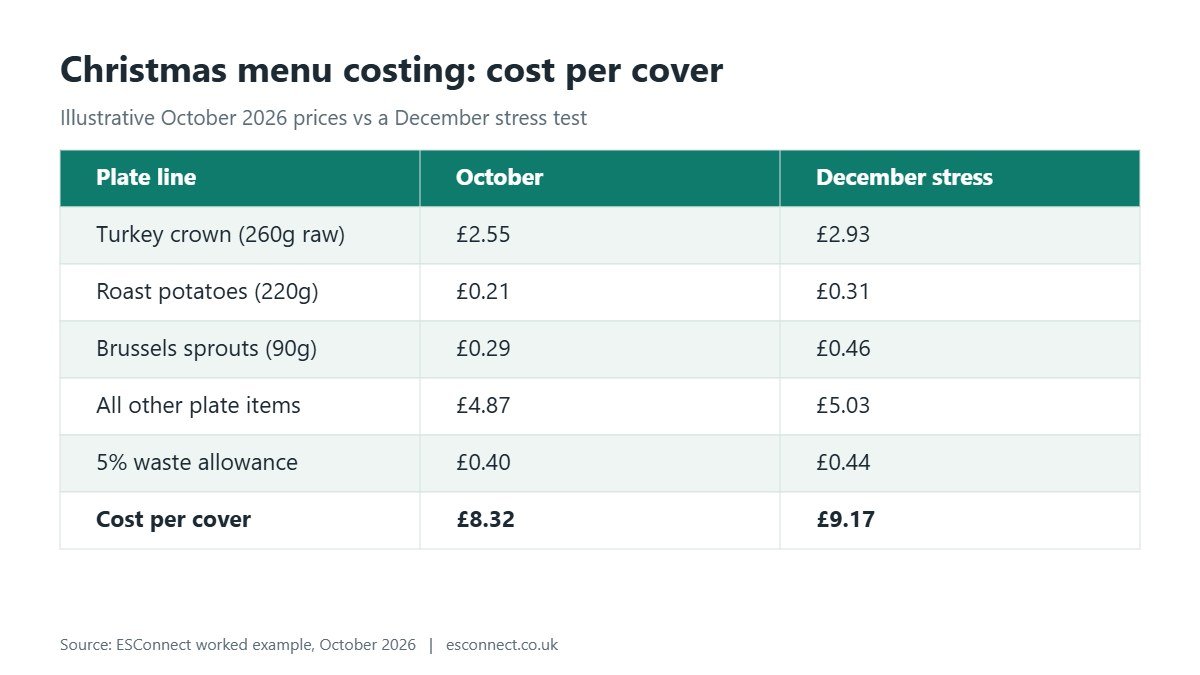
At £36, you keep £30 per cover. In October your food cost is 27.7%, a GP of 72.3%. Under the December stress test it rises to 30.6%, a GP of 69.4%.
If your target is 70%, you miss it by 17p a plate. Across 900 covers in a four-week season, that is roughly £150 lost before any portion creep.
What Is the VAT Trap in Christmas Menu Costing?
The most common mistake in Christmas menu costing is dividing by the price on the menu. A £36 price includes £6 of VAT, and that money goes to HMRC.
Divide £8.32 by £36 and you get 23.1%. That looks comfortable. Divide it by the £30 you actually keep and the real food cost is 27.7%.
That 4.6-point gap can turn a menu that “hits target” into one that loses money. So always use this rule:
Net selling price = menu price ÷ 1.2
Then work out food cost against the net figure. This applies at the standard 20% VAT rate, which covers food served in pubs and restaurants.
How Should You Set Your Christmas Menu Price?
Do not base your Christmas menu costing on October prices and hope they hold. Instead, work backwards from the December stress cost with one formula:
Required net price = stress cost per cover ÷ (1 − target GP)
- Find the net price: £9.17 ÷ 0.30 = £30.57.
- Add VAT: £30.57 × 1.2 = £36.68.
- Round to a price your market accepts: £37. That is £1 above the 2025 chain average.
- Check the result: at £37 you keep £30.83. Your stress-case GP is 70.3% and your October-case GP is 73.0%.
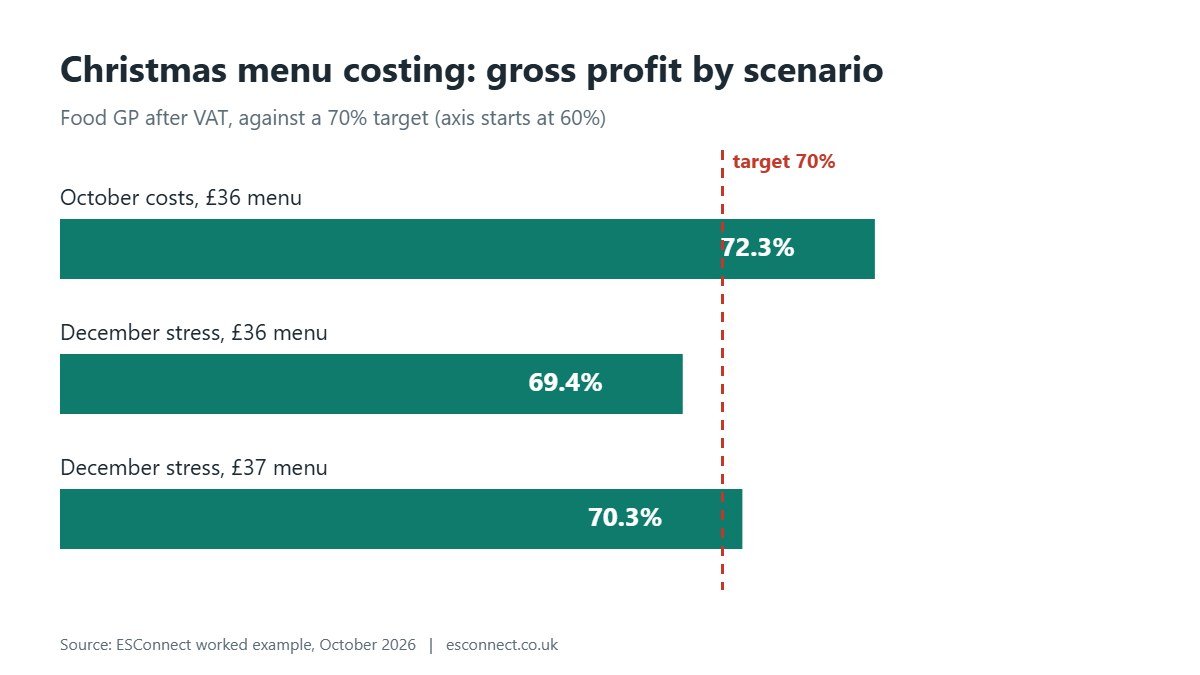
Moving from £36 to £37 adds 83p of net income per cover. On 900 covers that is about £750, which is enough to absorb the December rises in our example.
The £36 figure is a chain average, so an independent charging £48 has more room in pounds. However, the method stays the same at any price.
If £37 is too high for your trade, change the plate, not the target. A soup starter costs about £0.60 instead of £1.40. Two pigs in blankets instead of three saves 26p. Our guide to menu engineering shows how to rank dishes by margin as well as popularity.
How Do You Cost a Choice Menu?
Most festive menus offer two or three mains. On a choice menu, one turkey plate is not enough for accurate Christmas menu costing, so cost each main separately. Then check the menu two ways: by the expected mix and by the dearest plate.
| Main course | October cost | December stress | Expected share |
|---|---|---|---|
| Turkey crown, pigs in blankets, stuffing, gravy, vegetables | £4.47 | £5.19 | 70% |
| Mushroom and chestnut wellington, vegetables, vegetarian gravy | £2.94 | £3.34 | 20% |
| Roast hake fillet, vegetables, beurre blanc | £4.59 | £5.62 | 10% |
| Weighted main cost | £4.18 | £4.86 |
Set the price on the weighted mix. Then set a minimum GP for any single plate, for example a 68% floor. Here, a hake cover under the stress test costs £9.62 with the waste allowance. At £37 that is a 68.8% GP, so it clears the floor.
If one option fails this check, cap its pre-orders or take it off the menu.
Which Ingredients Are Risky in 2026?
Your Christmas menu costing only protects you if your buying matches it. Here is how the 2026 risks turn into buying actions.
| Ingredient | 2026 risk (Lynx, September 2026) | Buying action |
|---|---|---|
| Potatoes | Drought-hit crop, smaller and lower-quality tubers | Agree a fixed or capped December price now. Cost frozen roast potatoes as a back-up. |
| Sprouts and brassicas | Late planting, cauliflower already short | Write “seasonal greens” on the menu so a swap does not break the description. |
| Turkey | Broadly in line with last year, but higher feed costs and avian flu risk | Confirm sizes, quantities and dates in writing. Ask what a back-up bird would cost. |
| Salmon and fresh fish | Salmon high on strong demand; fresh fish up on lower availability and quota limits | Use cured or smoked salmon bought at a confirmed price. |
| Salad items | European crops hit by drought and wildfires | Keep salad as a garnish, not a main component. |
Talk to your fruit and veg wholesaler about potatoes and greens first. Then speak to your meat wholesaler about turkey, and to your seafood supplier about fish.
Whenever you swap a product, update your allergen information at the same time. A new stuffing or gravy base can add celery, sulphites or gluten. Under the Food Information Regulations 2014, you must give accurate information on the 14 major allergens in every dish you serve.
How Do Pre-Orders Cut Festive Waste?
Most festive waste starts when orders come from gut feel instead of your Christmas menu costing. Group pre-orders give you better data than any forecast, so use them.
- Set a deadline 7-10 days before each party, and link the deposit to it.
- Order to raw weights. With 180g of cooked turkey per cover and about 30% roasting loss, 100 covers need about 26kg of raw crown, not 18kg.
- Plan fewer, larger deliveries. In its Summer 2026 forecast, Lynx Purchasing reported that suppliers are adding surcharges, cutting delivery days and raising minimum orders.
- Check batch yields for gravy, stuffing and red cabbage before the first party.
Good stock control also stops last-minute top-ups. Our guide to restaurant inventory management covers par levels and stock counts.
What Does Food GP Not Show?
If your Christmas menu costing covers food only, a wrong December rota can still lose you money. Before you sign off the price, add three more numbers.
Labour per cover
Divide your extra festive wage bill by your forecast covers. Include extra shifts, agency chefs and holiday pay. Then judge the menu on food plus labour, not food alone.
Drinks
An arrival drink or wine package often earns more cash margin than the food. Cost it as a separate line, and do not give it away to make the food price look lower.
Deposits and cancellations
Take a per-head deposit tied to the pre-order deadline. Write down what happens if numbers drop after that date, because no-shows on a fixed order are pure waste.
Common Christmas Menu Costing Mistakes
These five errors cost UK operators the most margin each December.
Costing against the VAT-inclusive price
Dividing by the menu price instead of the net price hides about 4.6 points of food cost on a £36 menu. The menu looks profitable on paper while it loses money in practice. Always divide the menu price by 1.2 before you calculate anything.
Using October prices for December food
Your costing is only as good as the prices behind it. A price file from early autumn will not reflect drought-hit potatoes or late sprouts. Stress-test the high-risk lines, or ask suppliers for written December prices.
Forgetting the small items
Crackers, bread, sauces and garnish can add £1 or more per cover to your Christmas menu costing. On 900 covers that is £900 of cost that never appears in the plate calculation. List every component, even the ones you buy in.
Costing only the turkey plate
On a choice menu, the dearest main sets your floor. A fish or premium beef option can cost a pound more than turkey under December prices. Cost every main and check it against your minimum GP.
Leaving out waste
Without a 5% allowance, your Christmas menu costing will look better than the real result. Trim, over-production and returned plates all rise in December. Build the allowance in from the start rather than hoping for a tidy kitchen.
How Can Procurement Protect Your Christmas Margin?
The weeks between your Christmas menu costing and the first service are a buying problem as much as a kitchen one. Before the menu goes to print, ask each key supplier for three things in writing:
- a December price for your top 10 festive lines
- the date that price is valid until
- its substitution policy if a line runs short
A workable clause reads: “Substitutes must be of equivalent specification at the same or lower price, with any change notified at least 48 hours before delivery.” If a supplier will not confirm December prices, put more of your stress buffer on its lines.
If you are already dealing with supplier price increases, compare the market before you accept festive prices. Our guide to supplier negotiation explains how to push back.
At ESConnect, our hospitality procurement team benchmarks price files and negotiates fixed pricing across meat, produce and dry goods for pubs, hotels and restaurants.
When Should You Redo Your Christmas Menu Costing?
Treat your Christmas menu costing as a live document, not a one-off. Re-cost the menu whenever one of these happens:
- a supplier sends a new price file, usually in November
- any high-risk line moves by more than 5%
- you change a recipe, portion or supplier
- pre-orders show a very different mix of mains from your plan
During December, a quick weekly check of the top five lines is enough for most sites.
Christmas Menu Costing Checklist
- Cost the whole plate, including crackers, bread, sauces and garnish.
- Add a 5% waste allowance.
- Remove VAT before you calculate food cost (menu price ÷ 1.2).
- Stress-test potatoes, sprouts, fish and turkey at December prices.
- Set the price from the stress cost, then round it.
- Cost every main and check the dearest plate against a minimum GP.
- Add labour per cover and cost drinks separately.
- Get written December prices and substitution terms from key suppliers.
- Use flexible menu wording and update allergen information on every swap.
- Link deposits to pre-orders, and order to raw weights.
Final Thoughts
The single most useful number in your Christmas menu costing is the stress-case GP: food cost at December prices, divided by the price after VAT.
If that still meets your target, you can publish the menu with confidence. When it falls short, change the plate or the price now, while you still can.
For a second pair of eyes on your festive costings and price file, get in touch with the ESConnect team. Send us your draft menu and supplier prices, and we will show you where December will test your margin.
Frequently Asked Questions
1. What is Christmas menu costing?
Christmas menu costing is the process of calculating the full food cost of one festive cover and comparing it with the menu price after VAT. It shows your food cost percentage and gross profit, so you can set a price that still makes money when December ingredient prices rise.
2. What gross profit should a Christmas menu make?
Many UK pubs and restaurants aim for around 68-72% gross profit on a festive set menu, calculated on the price after VAT. Set menus can often beat your usual GP, because portions are fixed and pre-orders cut waste.
3. How much does a Christmas dinner cost per person to make?
It depends on portions and supplier prices. In our worked example, a three-course turkey menu costs £8.32 per cover at October 2026 prices and £9.17 under a December stress test, including a 5% waste allowance.
4. When should I start my Christmas menu costing?
Start your Christmas menu costing before the menu is printed or published, usually in September or October. That gives you time to get written December prices from suppliers and adjust the plate before deposits are taken.
5. Can I change my Christmas menu prices after publishing?
You can change prices for new bookings. However, raising the price for guests who have already booked and paid a deposit risks complaints. It is safer to build a price buffer in from the start and protect margin through the plate itself.
6. Do I charge VAT on Christmas party deposits?
Generally, yes. HMRC treats a deposit as a part payment, so VAT is usually due when you receive it, not when the party takes place. Check refundable deposits and gift cards with your accountant before December.
7. How early should I order turkey for Christmas?
Confirm turkey quantities and crown sizes with your supplier by early November, while choice is still wide. Ask at the same time which back-up bird or cut it would supply if avian flu cuts availability, and get that price in writing.
8. How does Christmas menu costing work for a vegetarian main?
Cost it in exactly the same way as the turkey plate: every component, portion by portion, plus the shared vegetables and a 5% allowance. In our example, a mushroom and chestnut wellington main costs £2.94, so it lifts the weighted margin.
9. Which festive foods are most profitable?
Starters and desserts with low ingredient costs, such as soups and Christmas pudding, usually carry the best margins. Our guide to the most profitable food in a restaurant explains why.
10. Is Christmas menu costing different for hotels?
The method is the same, but hotels often add banqueting packages, room-hire minimums and drinks bundles. Cost the food per cover first, then add each package element as a separate line so you can see where the margin comes from.