
Food traceability is your legal duty to know who supplied every food and ingredient in your kitchen, and which business you passed food on to. Most kitchens only test it when a food alert lands mid-service and nobody can say which delivery the chicken came from.
Food incidents are not rare. The Food Standards Agency (FSA) was notified of 2,073 food and feed safety incidents in England, Wales and Northern Ireland in 2025/26, up 14% on the year before.
This food traceability guide covers what the law asks of restaurants, pubs and hotels, the records to keep, six set-up steps and a £ example from a 45-bedroom hotel. Most of what you need arrives on supplier paperwork, which is why traceability belongs in hospitality procurement as much as in food safety.
Jump to a section:
- What it is
- The law
- Records to keep
- Foods with extra rules
- How long to keep them
- 6 set-up steps
- Mistakes
- £ example
- Food alerts
- Checklist
- FAQs
What Is Food Traceability?
Food traceability means following a food and its ingredients through the supply chain, so you can see where it came from and where it went.
The law reduces this to a simple test, known as one step back, one step forward. Can you name the immediate supplier of everything you receive? And can you name any business you supplied with food?
A third layer, internal traceability, links what came in to what you made. FSA guidance treats it as best practice rather than a legal duty, but it decides how much stock you bin in an incident.
| Type | The question it answers | Kitchen example |
|---|---|---|
| Backward (one step back) | Who supplied this? | The salmon came from your fish wholesaler on Tuesday’s drop |
| Forward (one step forward) | Which business did we supply? | Twenty trays of brownies went to the café next door |
| Internal | What did we make with it? | Tuesday’s salmon went into Wednesday’s fishcake batch |
Is Food Traceability a Legal Requirement in the UK?
Yes. Food traceability is a legal duty for food businesses under Article 18 of assimilated Regulation 178/2002, usually called General Food Law. No size exemption exists, so a one-chef café has the same duty as a 200-bedroom hotel.
The FSA published fresh food traceability guidance on 14 October 2026. It points to existing law rather than a new duty, but it makes one thing plain: record batch or lot codes whenever a pack shows them, because the FSA calls that best practice for every business.
Diners are not a forward step. Food traceability rules generally need no forward records for sales to the final consumer, so nobody expects a log of who ate which dish. But the full rules apply as soon as you supply another food business.
Your local authority enforces this, usually through an environmental health officer. Records must be accurate and readily available when an authorised officer asks. A breach is a criminal offence, and the most serious cases can bring a fine or up to two years in prison.
The GOV.UK guidance covers England, Wales and Northern Ireland, although EU food law still applies directly in Northern Ireland. Food Standards Scotland publishes its own version for Scottish businesses.
What Food Traceability Records Should a Kitchen Keep?
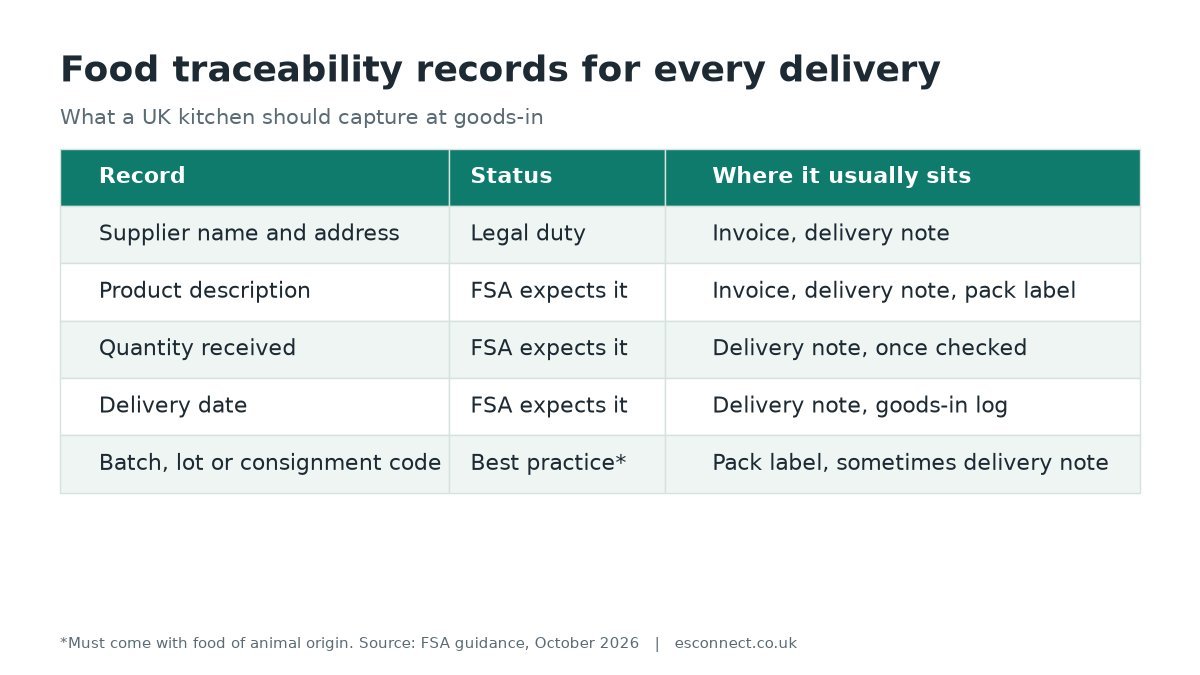
Food traceability records should identify five things for every delivery: the supplier, the product, the quantity, the date and, where available, the batch code. Article 18 itself requires you to identify suppliers and business customers, and the fuller list comes from FSA guidance.
| Record | Status | Where it usually sits |
|---|---|---|
| Supplier name and address | Legal duty | Invoice, delivery note |
| Product description | FSA expects it | Invoice, delivery note, pack label |
| Quantity received | FSA expects it | Delivery note, once checked against the drop |
| Delivery date | FSA expects it | Delivery note, goods-in log |
| Batch, lot or consignment code | Must come with food of animal origin; best practice for the rest | Pack label, sometimes the delivery note |
Most of this already sits in your invoices and delivery notes. Safer Food, Better Business, the FSA’s pack for caterers, says keeping all invoices and receipts is usually the easiest route. No format is prescribed in law, so paper, a spreadsheet, a stock system and software are all acceptable if you can produce the information promptly.
The weak point is the batch code. Many invoices leave it out, so it lives on a carton that goes in the recycling by 10am. That is why a goods-in habit matters more than any app.
Which Foods Need Extra Traceability Records?
Meat, fish, dairy, eggs, shellfish and sprouted seeds carry extra food traceability rules on top of general food law. Your supplier does most of the work, but your kitchen still holds the paperwork.
| Food | Rule | What your kitchen should do |
|---|---|---|
| Food of animal origin (meat, poultry, fish, dairy, eggs) | Assimilated Regulation 931/2011 | Expect the description, quantity, sender, recipient, lot reference and dispatch date from your supplier, then keep them until the food is likely to have been eaten |
| Live oysters, mussels and clams | Assimilated Regulation 853/2004 | Keep the bag label for at least 60 days after you split the bag |
| Sprouted seeds | Assimilated Regulation 208/2013 | Keep the supplier’s lot details with the delivery record |
| Eggs | Assimilated Regulation 589/2008 | Keep the tray or case label with the delivery record |
| Fresh and frozen beef and veal | Compulsory Beef Labelling Scheme | Keep the label reference, which links back to the supplier’s records |
So if you buy chicken, the answer on lot codes is yes: your supplier must give you the reference, and you should be able to produce it.
The shellfish rule catches people out, because the bag label often goes in the bin with the empty shells. “Retail” in that rule legally includes restaurants and caterers, so staple the label to the delivery note instead.
Traceability in food also exposes substituted or mislabelled lines, which makes it a useful tool for preventing food fraud.
How Long Should You Keep Your Records?
For most food traceability records, no single legal period exists. FSA guidance on traceability and recalls says each business decides, based on the food’s life span and when an officer might ask for the information.
Safer Food, Better Business gives the practical test: keep records until you are sure the food was eaten without problems. Regulation 931/2011 uses almost the same wording for animal products, and the FSA’s best-practice benchmark for pre-packed food is the shelf life plus 12 months as a minimum.
That test is hard to apply when one delivery note covers fresh, frozen and ambient lines, so set one house rule. Ours is a suggestion, not the law, apart from the two legal periods marked:
- Delivery notes and label photos: 3 years, filed by month, because a personal injury claim over food poisoning can generally be brought up to three years later.
- Live shellfish bag labels: at least 60 days after opening (legal minimum).
- Invoices: at least 6 years if you are VAT-registered (an HMRC rule, not food law).
How to Set Up Food Traceability in 6 Steps
You can set up the basics of food traceability within a week, using documents you already receive.
Step 1: Build Food Traceability Into Supplier Set-Up
Ask every supplier, new or existing, for its registered address, proof of local authority registration and allergen information. Then ask whether batch codes can appear on delivery notes, and write that and an out-of-hours recall contact into the contract, so food traceability does not stop at 5pm.
Record the answers on your approved supplier list. Safer Food, Better Business also suggests checking for fully referenced invoices, so add that to your questions for food suppliers.
Step 2: Check the Paperwork at Goods-In
Goods-in is your first food traceability check. Whoever signs for a delivery compares the note with what actually arrived. Short deliveries and swaps get written on the note before the driver leaves. If you sign on a handheld, or the drop arrives unattended, email the rep that morning and keep the email.
Do this alongside your cold chain checks, so one person handles temperature, quantity and paperwork in one pass.
Step 3: Capture Batch Codes for High-Risk Lines
Food traceability that logs every code across 200 lines will not survive a busy week. Start with raw meat, poultry, fish, shellfish, eggs, dairy, ready-to-eat items and free-from lines.
A photo of the pack label on the kitchen phone works, because the law sets no format. Save it in a folder named by date. If a butcher’s or fishmonger’s pack shows no code, ask the supplier for the lot reference.
Step 4: Keep the Details With the Food
Decanting is where food traceability usually dies. When someone tips 10 kg of rice into a tub, the supplier’s label goes in the bin.
So add the supplier and delivery date to your day-dot label, or tape the original label to the tub. Your stock control routine should already date every tub, so this adds one field.
Step 5: Link Prep Batches to Deliveries
Add one line to your production sheet or prep book for sauces, cook-chill dishes and portioned proteins: the delivery date of the main ingredient and of anything carrying an allergen. Then a food recall on one chicken batch does not condemn every pie in the freezer.
Step 6: Test It With a 15-Minute Drill
FSA guidance says businesses should review their recall plan every year, and a mock exercise is one way to do it. Pick any high-risk line in the walk-in and ask whoever is on duty, ideally on your day off, to find the supplier, delivery date, batch code and any dish made with it.
Aim for under 15 minutes. That target is ours rather than a legal limit, but it keeps the test honest. Repeat it each quarter.
Common Food Traceability Mistakes
Most food traceability failures come from everyday shortcuts, not from missing software.
Forgetting Emergency Shop Runs
A sous chef buys six chickens from a supermarket at 6pm and pays from the till. That shop is now your supplier, so keep the receipt and photograph the label. Cash and carry trips count for food traceability too.
Not Recording Substitutions
A wholesaler swaps a brand at 5am, but the delivery note still shows the original product. Correct the note at the door, then recheck the allergens. Your food supplier contract should say how swaps get notified.
Sending All the Paperwork to Head Office
In many groups, invoices go to accounts and never come back. At 9pm on a Saturday nobody can open that system. If your purchase to pay process is centralised, keep delivery notes on site or in a shared folder the duty manager can open.
Forgetting You Are a Supplier
Selling brownies to a neighbouring café or sending sauces to a separately owned sister site makes you a supplier. One step forward now applies, so raise a simple note with the product, quantity, date and batch.
Assuming the Wholesaler Will Handle It
Your wholesaler can usually find a batch, but only in office hours and only for its own products. The legal duty stays with you, and an officer will ask you first.
Food Traceability Example: The Cost of One Bad Batch
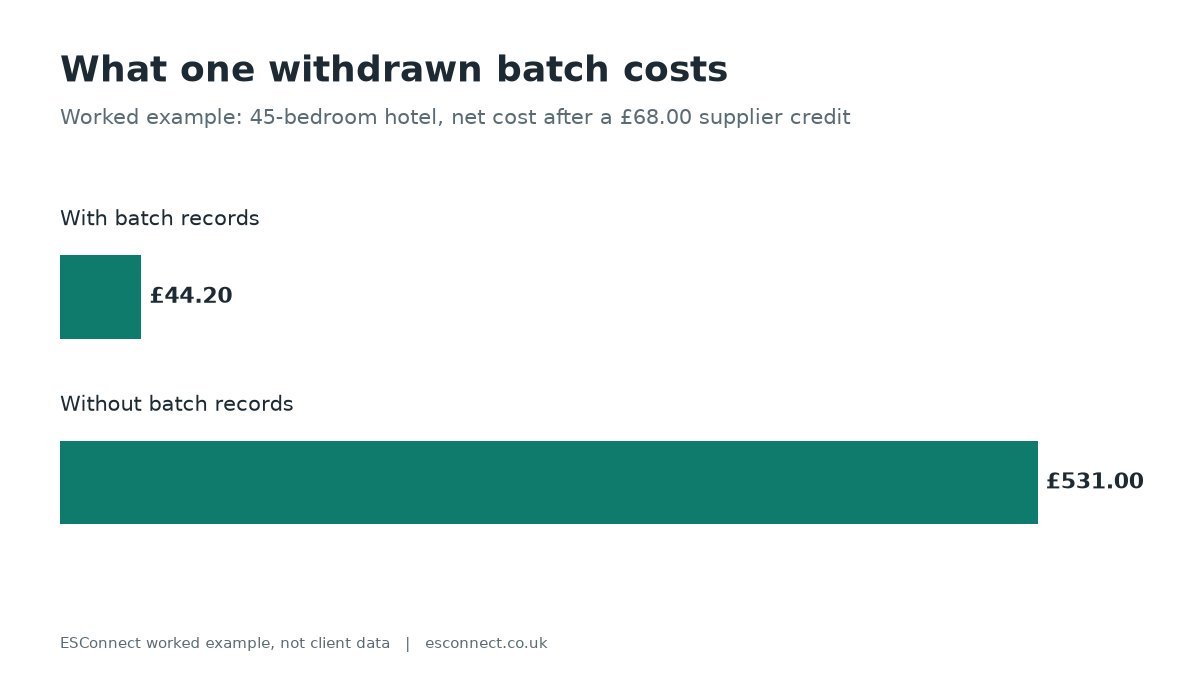
Good food traceability pays back the first time something goes wrong. This illustrative example is an ESConnect worked calculation, not client data.
A 45-bedroom hotel holds 38 kg of chicken breast from three deliveries, plus 46 prepared portions. At 5pm on a Saturday, an alert names one batch from its wholesaler. That batch covers 10 kg of raw stock and 12 portions, but only batch records can show this.
| Cost line | With batch records | Without batch records |
|---|---|---|
| Raw chicken binned at £6.80/kg | £68.00 (10 kg) | £258.40 (38 kg) |
| Prepared portions binned at £3.10 | £37.20 (12) | £142.60 (46) |
| Staff time at £14 an hour | £7.00 (30 minutes) | £84.00 (6 hours) |
| Lost gross profit at £9.50 a dish | £0 | £114.00 (12 dishes, until a chef buys more) |
| Total cost | £112.20 | £599.00 |
| Less supplier credit (10 kg) | -£68.00 | -£68.00 |
| Net cost | £44.20 | £531.00 |
The gap is £486.80 on a single alert. It exists because the law treats a whole batch as unsafe unless you can show otherwise. Without codes, the hotel cannot show that its other two deliveries came from a different batch, and the wholesaler’s office is shut until Monday. So the chef bins the lot.
The binned stock then needs correct handling too, under the rules in our guide to food waste legislation.
What Should You Do When a Food Alert Lands?
Stop using the food straight away, then follow the instructions from whoever issued the alert. A food withdrawal removes food from the supply chain, while a food recall also asks consumers to return or dispose of what they bought.
- Match it. Check the product, batch code and date against your food traceability records. If you cannot match it, ring the supplier and hold all of that line until you know.
- Isolate it. Move the stock away from other food, label it “do not use” and tell the team.
- Check your prep. Look through production sheets and the freezer for dishes made with it. In a hotel, include the bar, banqueting and room service stores.
- Follow directions. Return or dispose of the stock as the supplier instructs, then claim your credit in writing.
- Update service. Change the menu and your allergen matrix if the swap affects them.
Caterers selling prepacked food to take away, such as sandwiches or jars in a hotel shop, have extra recall duties. These can include telling customers and accepting returns.
If a diner reports illness, note the date and dish, then check that batch. If you think unsafe food has already been served, or you find a safety problem yourself, contact your local authority food safety team straight away. Article 19 requires you to inform the authorities immediately if you believe food you supplied may harm health. Sign up for the FSA’s free email alerts too, so a food recall does not reach you second-hand.
How Better Purchasing Makes Traceability Easier
Paperwork is easiest to fix when a supplier is first set up, because you can still ask for what you will need later. Traceability is also simpler with fewer suppliers, and a supplier that cannot support food traceability on its paperwork is a poor fit for high-risk lines.
Three buying decisions make the biggest difference:
- Set the standard at onboarding. Supplier onboarding mistakes often include never asking how batch details are shared.
- Raise purchase orders. With purchase order control, each delivery has a reference that ties together the order, the note and the invoice.
- Go digital where it pays. E-procurement keeps supplier documents searchable, so nobody hunts through box files mid-service.
ESConnect handles buying and supplier management for operators through its network of distributors, from New Covent Garden Market in London. If you use a buying partner, as with our hotel procurement service, supplier set-up is the time to agree these paperwork standards.
Food Traceability Checklist
Use this food traceability checklist to audit your kitchen this week.
- Every active supplier is on your approved list, with its full address.
- Delivery notes are checked and corrected at the door.
- Batch codes are captured for high-risk lines.
- Decanted food carries the supplier and delivery date.
- Prep sheets show the delivery date of the main ingredient.
- Receipts are kept for every shop run and cash and carry trip.
- Live shellfish labels are held for at least 60 days.
- Any food sold to another business has its own record.
- Records can be opened on site, including at weekends.
- A named person runs the 15-minute drill each quarter.
Final Thoughts
Good food traceability is mostly a goods-in habit. If the person signing for deliveries checks the note and captures the code on your riskiest lines, most of the work is done.
Make one decision this week. Pick your five highest-risk lines, capture their batch codes for a month, then run the 15-minute drill and see what breaks.
If supplier paperwork turns out to be the problem, the fix sits with your buying. Talk to ESConnect about tidying up your supplier set-up before the next alert lands.
Frequently Asked Questions
1. Does food traceability apply to a home baker or market stall?
Yes. A home baker, market trader or pop-up has the same duty as a restaurant, with no minimum turnover. Invoices, receipts and delivery notes in date order are usually enough. Selling to another business, such as a local café, adds forward records.
2. Do restaurants have to record batch numbers?
Not for every product, though you should for chicken and other food of animal origin. The FSA calls batch, lot or consignment codes best practice for all businesses where they are available, so capture them on high-risk lines even if you skip dry goods.
3. Is a delivery note enough for food traceability?
Usually, if it shows the supplier, product, quantity and date, and you corrected it for any short delivery or swap. It rarely shows batch codes, though. Pair it with a photo of the pack label on high-risk lines, and you cover both the law and best practice.
4. Do I need records for produce from a local grower?
Yes. Article 18 refers to any person who supplied you, so an allotment neighbour, forager or local farmer counts. Record their name, address, the product, the quantity and the date. Check first whether they should be registered as a food business with their local authority.
5. What does an environmental health officer ask to see?
An officer may pick a product and ask where it came from, then expect you to show the invoice or delivery note. Expect questions about your supplier list and allergen information too. Weak records can count against you in the management part of your hygiene rating.
6. Does traceability cover packaging?
Yes. The FSA’s October 2026 guidance says traceability requirements also apply to food contact materials. That means takeaway tubs, film, foil and similar items that touch food. Keep supplier invoices for these lines in the same way as you do for ingredients.
7. Do stock transfers between sites need records?
Keep a simple transfer note either way, showing the product, quantity, date and batch. If the other site is a separate legal business, this is a forward step in law. Even within one company, untracked transfers leave a gap that makes a food alert harder to handle.
8. Can I use an app for food traceability records?
Yes. The law sets no required method, so paper, spreadsheets and apps are all allowed. An app helps most when staff scan labels at goods-in. But no app can fix missing supplier details, so sort out your supplier paperwork before you pay for a subscription.