
The cold chain is the unbroken run of chilled and frozen storage that keeps food at a safe temperature from the producer to your guest’s plate. In a restaurant, pub or hotel it covers the supplier’s depot, the delivery van, your back door, your fridges and the pass.
Your kitchen is the last link. Once you sign the delivery note, the food and its temperature are your responsibility.
Losing stock also hurts more right now. The BRC put UK food inflation at 2.9% in October 2026, up from 2.5% in September, and its October Shop Price Monitor blamed high energy and transport costs.
This guide explains how the cold chain works, the UK temperatures that matter, six goods-in checks and what one warm delivery really costs. It is part of how we approach supply chain management for hospitality, because many temperature problems start with supplier and delivery decisions.
Jump to a section:
- What the cold chain is
- Why it matters
- UK temperatures
- Depot and van
- 6 goods-in checks
- A £ example
- Costly mistakes
- Supplier rules
- Records
- Checklist
- FAQs
What Is the Cold Chain?
Put simply, the cold chain is a supply chain with temperature control at every step. If one link warms up, the links after it cannot undo the damage.
Cold slows the bacteria that cause food poisoning and spoilage. It does not kill them, so chicken that sat at 12°C in a van for an hour is not “reset” by your walk-in.
In food service, the cold chain runs in two streams. Chilled covers fresh meat, fish, dairy, cooked meats and prepared salads. Frozen covers lines such as ice cream, chips, frozen seafood and pastry.
| Link in the cold chain | Who controls it | Typical weak point |
|---|---|---|
| Producer or packer | Manufacturer | Product not cooled fast enough after packing |
| Wholesale depot | Supplier | Orders waiting on an open loading bay |
| Delivery van | Supplier or haulier | Doors opening at every stop on a long route |
| Back door and goods-in | You | Boxes left outside, no probe check |
| Walk-in, fridges and freezers | You | Overloading and doors propped open |
| Prep and service | You | Trays left on benches between jobs |
Half of that table belongs to you. The last 30 metres, from the van door to your fridge, is where you have the most control and often the weakest habits.
Why Does the Cold Chain Matter for UK Restaurants and Hotels?
The cold chain matters because it decides whether food is safe, whether you stay within the law and how much stock ends up in the bin.
Food safety. High-risk foods such as cooked meats, soft cheese, smoked fish and prepared salads can carry Listeria. Every hour outside the cold chain gives bacteria extra time to grow.
The law. In England it is an offence to keep chilled food above 8°C. If a guest falls ill, good delivery and fridge records help you prove a due diligence defence.
Your hygiene rating. Temperature control is one of the first things an Environmental Health Officer checks. Missing fridge logs or a warm walk-in will cost you points on the day.
Money. A chiller that fails over a weekend can write off thousands of pounds of protein. Small daily breaks in the cold chain cost money too, because food that warmed up spoils sooner.
Spoiled stock also adds to the food waste that businesses in England with 10 or more employees must now separate for collection under England’s food waste rules.
What Temperature Should the Cold Chain Be in the UK?
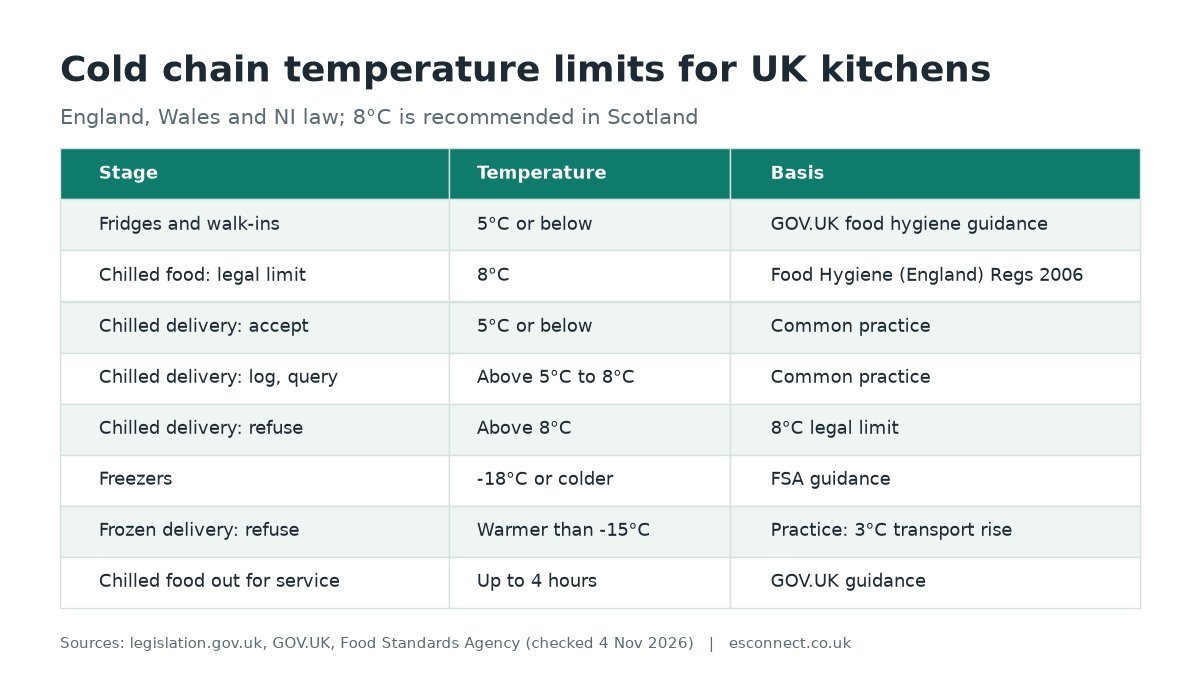
The key cold chain temperature figures for a UK kitchen are 8°C as the legal ceiling for chilled food, 5°C or below as the working target and -18°C for frozen food.
Chilled Food: 8°C Is the Law, 5°C Is the Target
Schedule 4 of the Food Hygiene (England) Regulations 2006 makes it an offence to keep food that needs chilling above 8°C. Wales and Northern Ireland have matching rules in their own 2006 regulations.
GOV.UK’s food hygiene guidance for businesses adds a working target: set fridges to 5°C or below. That gap gives you a buffer for door openings during service.
The law allows a few defences. Food on service or display for under four hours, once, falls within them. So do short rises while you move food to or from a vehicle, and unavoidable ones such as a fridge defrost cycle.
Frozen Food: -18°C or Colder
Frozen food should sit at -18°C or colder, the standard Food Standards Agency figure. Quick-frozen food rules allow a brief rise of no more than 3°C in transport, so many kitchens refuse a frozen delivery that reads warmer than -15°C.
Also check that it feels frozen solid. Soft edges, ice crystals inside the bag or prawns stuck together in one block all suggest the product thawed and refroze.
Vacuum-Packed Food: The 10-Day Rule
Vacuum packs add an extra cold chain risk. Non-proteolytic Clostridium botulinum can grow without air from 3°C upwards, and you cannot see or smell it.
So FSA guidance caps vac-packed and modified-atmosphere chilled food held between 3°C and 8°C at a 10-day shelf life, unless other controls apply. Check the dates on vac-packed fish at delivery, and follow the same rule if you vac-pack in-house.
Scotland Words the Law Differently
Scotland has its own Food Hygiene (Scotland) Regulations 2006. They require food to sit in a fridge, chill room or cool, ventilated place, or hot above 63°C. GOV.UK’s guidance treats 8°C as recommended in Scotland, so Scottish kitchens can work to the same 5°C and 8°C figures.
Before Your Back Door: The Depot and the Van
Two links of the cold chain sit outside your kitchen, but your buying choices still shape them.
Where the Cold Chain Starts: The Supplier’s Depot
Good wholesalers pick chilled orders inside a chilled area and load them onto a van that is already cold. Ask your account manager how long your order waits on the loading bay, and whether that bay has temperature control.
In the Delivery Van
A refrigerated van holds its air temperature, but every door opening lets warm air in. A van with 20 or more drops before yours can arrive warmer than one that reaches you third. The display in the cab shows air temperature, not the temperature of your food.
How to Check a Chilled or Frozen Delivery: 6 Steps
A temperature and date check adds about three minutes to each chilled or frozen drop. It catches most problems before anyone signs.
Step 1: Book a Window and Name Who Signs
Agree a slot when a trained person is on site, for example 7:30am to 9:00am before prep starts. Name the people allowed to sign for goods-in, and do not leave it to the newest kitchen porter on their own.
Ask your account manager to add “no unattended drops for chilled and frozen” to your account notes.
Step 2: Look at the Van Display
Check the van’s temperature display before the driver unloads. Most drivers cannot print logger data at the door. If readings keep coming in high, ask your account manager for the van’s cold chain records.
Step 3: Probe Between Packs, Then Confirm
Slide a clean probe between two packs or cases, rather than through sealed packaging. Test a case from the middle of the load as well as the top, because warm air hits the top layer first.
Between-pack readings can mislead. If one is over your limit, confirm it with a core reading on a single pack you are willing to lose before you refuse the delivery.
Step 4: Check Dates, Packaging and Thaw Signs
Look for use-by dates that leave you enough days to sell, torn vacuum packs and wet boxes. Next, match the delivery note to your order line by line, including weights.
Step 5: Accept, Log or Refuse
Use three bands for chilled food. At 5°C or below, accept it. Between 5°C and 8°C, accept it, log the reading and raise it with your account manager. Above 8°C, refuse it. Many chefs set a tighter 5°C limit for fish and shellfish.
When you refuse, record it on the driver’s handheld before signing and photograph the probe reading. Then ring the supplier for a credit and a second drop, and tell the pass which dishes may change.
Step 6: Put Everything Away Within 15 Minutes
Put frozen goods away first, then high-risk chilled food, then the rest, all within 15 minutes of the van leaving. Rotate as you go, so older stock stays at the front.
Cold Chain Example: What One Warm Delivery Costs a 70-Cover Restaurant
Here is a worked example with illustrative figures.
A 70-cover restaurant takes a £640 chilled delivery at 7:40am on a Friday: £380 of meat, £180 of fish and £80 of dairy. The van’s fridge has been struggling, and a core reading on a pack of chicken shows 11°C.
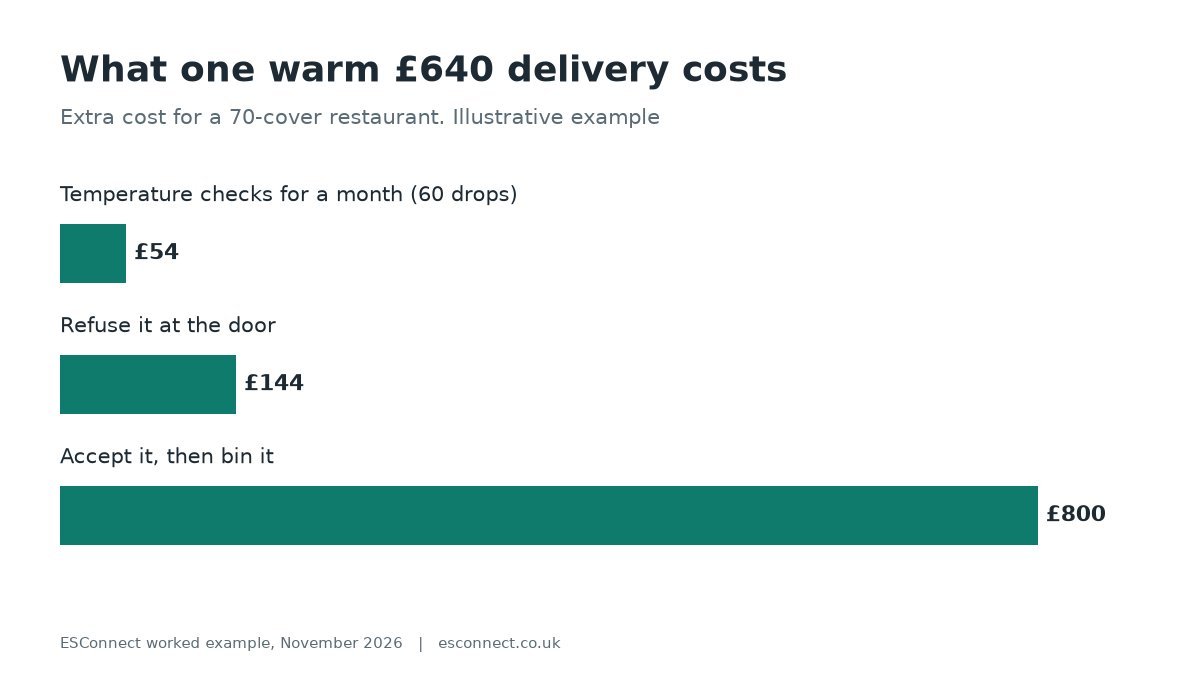
Option A: refuse it at the door. The driver records the refusal and the supplier credits the full £640. A second drop arrives on the afternoon run, so the fish special comes off the lunch menu. At £12 gross profit a cover, 12 lost covers cost you £144.
Option B: accept it, then bin it. Nobody probes, and in the walk-in the stock soon reads normal. By Saturday morning the fish smells off and the chicken is tacky, so £560 of meat and fish goes in the bin.
There is no credit, because you signed for goods in good order. Saturday lunch also runs short, which costs about 20 covers, or £240. In total that is £800, and it assumes no guest ate the warm stock.
| Cost line | Refuse at the door | Accept, then bin |
|---|---|---|
| Original £640 order | Credited in full | £560 of meat and fish binned, no credit |
| Lost gross profit while waiting for stock | £144 (12 covers at £12) | £240 (20 covers at £12) |
| Extra cost | £144 | £800 |
Checks do not stop a van arriving warm, but they change what it costs you. Three minutes for each of 60 chilled and frozen drops a month, at £18 an hour with on-costs, comes to about £54. That £54 turns an £800 cold chain failure into a £144 one.
7 Costly Cold Chain Mistakes in UK Kitchens
Many cold chain breaks come from habits that save a few minutes. Here are seven common ones.
1. Letting Drivers Leave Deliveries Outside
Early “key drops” save the driver time. But a crate of chilled meat on a sunny step at 6am can be well above 8°C by the time the kitchen opens at 8am.
2. Overloading the Walk-In Before a Busy Weekend
Fridges cool air, not food. When shelves are packed tight and boxes sit on the floor, cold air cannot move, and the back corner runs warm. Order to your par levels rather than filling every gap.
3. Propping Doors Open During Unloading
A walk-in door wedged open for a 15-minute unload lets the air warm by several degrees, and the compressor then works hard to recover. Fit a strip curtain and unload in batches instead.
4. Defrosting Food on the Bench
Thawing a case of chicken thighs on a worktop overnight leaves the outside warm for hours while the middle stays frozen. Defrost in the fridge on the bottom shelf, with a date label.
5. Cooling Big Batches Too Slowly
A deep pot of stock or a whole braise can stay warm for hours in the middle. Split it into shallow trays, use a blast chiller if you have one and get cooked food into the fridge within one to two hours.
6. Trusting a Probe Nobody Has Checked
A probe that reads 2°C low makes a 9°C delivery look like 7°C. Test it every month: it should read -1°C to 1°C in iced water and 99°C to 101°C in boiling water.
7. No Fridge Breakdown Plan
Keep the engineer’s number on the fridge door, plus a spare thermometer and a list of what to move first. In a power cut, keep doors shut: a full freezer holds its temperature far longer than a half-empty one.
Supplier Rules That Keep Food Cold
Much of the cold chain is settled before the van arrives, when you choose suppliers and set ordering rules.
Start with your approved supplier list. Agree limits with each supplier: chilled at 5°C or below (8°C maximum), frozen at -15°C or colder, vehicle records on request and a credit within 48 hours.
Then add delivery temperature to your hospitality supplier scorecard. A supplier who is 3% cheaper but keeps arriving at 7°C, right at your limit, is not cheaper.
Consolidate where you can, because fewer, larger deliveries mean fewer van visits, as covered in how delivery costs affect procurement.
Match delivery days to fridge space. A Thursday drop that sets you up for the weekend beats a Saturday top-up mid-service.
For the riskiest lines, use specialists whose vans and depots suit the product:
- UK meat wholesalers for fresh meat and poultry
- Wholesale seafood suppliers that pack on ice and deliver early
- Dairy suppliers for UK hospitality with chilled vans for cream and soft cheese
- A frozen products supplier with true freezer vans, not a chilled van with a frozen box
Finally, weigh reliability against price. As we explain in why reliable delivery matters more than price, one warm drop can cost more than a small discount saves.
Cold Chain Management Records: What Should You Keep?
Good cold chain management comes down to simple records your team actually fills in. They help prove due diligence if an inspector or a guest raises a problem.
- Delivery log: supplier, time, product, probe reading, accepted or refused and initials.
- Fridge and freezer log: readings at opening and closing, as in the Safer Food, Better Business daily diary.
- Refusal and credit log: what went back, why, and when the credit note arrived.
- Probe check log: the monthly iced-water and boiling-water results.
- Breakdown log: what failed, the readings, what you binned and when the engineer came.
Check fridges at least twice a day, probe every chilled and frozen delivery and test probes monthly.
Paper logs work. Wireless sensors add a safety net overnight, but set the alert at 8°C with a 30-minute delay, so deliveries and defrost cycles do not set it off.
Feed refused and binned stock into your restaurant inventory management figures too. Otherwise your food cost report hides the true loss.
Cold Chain Checklist for UK Kitchens
Use this cold chain checklist at every delivery and in every weekly review.
- Staffed delivery windows agreed with every chilled and frozen supplier
- Named, trained staff who sign for goods-in
- Calibrated probe and probe wipes kept at the back door
- Chilled deliveries accepted at 5°C or below, refused above 8°C
- Frozen deliveries refused if warmer than -15°C
- Goods put away within 15 minutes, frozen first
- Fridges at 5°C or below, freezers at -18°C or colder
- Readings logged at opening and closing
- Strip curtains fitted on walk-in doors
- Engineer’s number and breakdown plan on the fridge door
How ESConnect Helps Keep Deliveries Cold
ESConnect manages suppliers on behalf of operators, working with a network of local and international distributors. That lets us help set temperature, timing and credit rules with suppliers before the first drop.
Deliveries can be booked on any day of the week, so chilled and frozen drops can arrive when a trained person is on site to check them.
Final Thoughts
The cold chain only works if every link holds, and your kitchen is the final link you fully control.
Start at the back door. Book staffed delivery windows, probe every chilled and frozen drop, refuse anything above 8°C or warmer than -15°C, and log it.
Then look upstream. Choose suppliers with good vehicle records, ask for fewer and better-timed deliveries, and size orders to your fridge space.
If you want help setting those rules with your suppliers, talk to the ESConnect team.
Frequently Asked Questions
1. What is the cold chain in simple terms?
It is the chain of fridges, freezers and refrigerated vans that keeps chilled and frozen food cold from producer to plate. If any link warms up, the food loses shelf life and may become unsafe, even once it is cold again.
2. What cold chain temperature should chilled deliveries meet in the UK?
No warmer than 8°C, the legal limit in England, Wales and Northern Ireland and the recommended limit in Scotland. Many kitchens accept at 5°C or below, log anything between 5°C and 8°C and refuse above 8°C.
3. What temperature should frozen food be delivered at?
Frozen food should be at -18°C or colder. Transport rules allow a brief rise of up to 3°C, so many kitchens refuse anything warmer than -15°C, plus any product that feels soft or shows signs of thawing.
4. What is the difference between the cold chain and cold storage?
Cold storage is one link: a chiller, freezer or cold store. The cold chain is the whole journey, including transport and handling between those stores. You can have perfect fridges and still break the chain at the back door.
5. What are the two types of cold chain in food service?
Chilled and frozen. Chilled food is stored at 5°C or below and must not go above 8°C in England. Frozen food is held at -18°C or colder.
6. Who is responsible for the cold chain once food is delivered?
You are. The supplier is responsible until the goods are handed over, but once you sign the delivery note the temperature is your problem, so probe before you sign.
7. Can I accept a chilled delivery that reads 9°C?
No. Above 8°C you should refuse it, record the reading on the driver’s handheld and ask for a credit. If a between-pack reading is close to the limit, confirm it with a core reading on one pack first.
8. How often should I check fridge and freezer temperatures?
At least twice a day, at opening and closing, and after any delivery or long door opening. Busy sites add a mid-service check, and wireless sensors can watch your fridges overnight.
9. Which foods need the most cold chain control?
Fresh meat and poultry, fish and shellfish, cooked meats, soft cheese, dairy desserts, prepared salads and sandwiches. Vac-packed chilled food needs extra care, and frozen seafood and ice cream spoil fast once thawed.
10. What should I do if my walk-in fridge breaks down?
Keep the door shut, call your engineer and move high-risk food to working fridges first. Record the readings and times. Throw out chilled food that sat above 8°C for longer than your safety plan allows.