
A dark kitchen is a delivery-only commercial kitchen that cooks for apps and collection. It has no dining room, no shopfront and no walk-in customers.
Orders come in through apps such as Deliveroo, Uber Eats and Just Eat. A rider collects the bag, and the customer never sees where the meal was made.
In a June 2026 Food Standards Agency survey, 41% of food businesses audited in England used at least one of those three apps.
The margin is the hard part. VAT, commission and packaging can take half of each order before you pay a cook.
This guide explains how a dark kitchen works in the UK, the rules, the start-up costs and the per-order maths. Choosing a delivery-only site is a hospitality consultancy question as much as a cooking one, because the site, menu and suppliers all have to work together.
Jump to a section:
- What a dark kitchen is
- The 4 UK models
- Is it legal?
- Planning permission
- Start-up costs
- Profit per order
- Supplier set-up
- Packaging
- 7 steps to start
- Pros and cons
- Costly mistakes
- Launch checklist
- FAQs
What Is a Dark Kitchen?
Put simply, a dark kitchen is a food production site built for delivery orders only. It has a cooking line, extraction and cold storage, but no seats, no waiting staff and no door for diners.
UK public health researchers agreed a formal definition in 2025. Their consensus paper in Perspectives in Public Health describes “technology-enabled commercial kitchens operating primarily for delivery”.
You will also hear ghost kitchen (the US term), cloud kitchen and delivery-only kitchen. A virtual brand is something else: it is the name and menu customers see on the app, and one dark kitchen can run several of them.
Most orders follow the same path:
- The customer orders on an app or your own website.
- The ticket drops onto a tablet or kitchen screen.
- The team cooks, packs and seals the bag, ideally within 10 to 15 minutes.
- A rider collects it and the app tracks it to the door.
How Does a Dark Kitchen Work? The 4 Main UK Models
A dark kitchen runs on one of four models in the UK, and each sets your cost, control and risk.
| Model | Upfront cost | Control | Best for |
|---|---|---|---|
| Unit in a hub kitchen site | Low to medium | Medium (landlord’s rules) | Testing a brand in a new area |
| Your own leased trade unit | High | Full | Proven brands ready to grow |
| Extra brand in an existing restaurant | Very low | Full | Restaurants with quiet hours |
| Licensed or franchised delivery brand | Low to medium | Low (brand’s recipes and suppliers) | Operators who want a ready-made menu |
1. Hub kitchen sites
A landlord fits out a building with kitchen units and rents them to food brands. Gas, power and extraction come with the unit, so you can often trade within weeks. Check what the fee covers, because waste, cleaning, rider marshalling and turnover fees are often extra.
2. Your own leased unit
You lease a trade or industrial unit and fit it out yourself. You get full control, but you also carry the fit-out bill, the planning risk and a long lease.
3. A dark kitchen brand inside your restaurant
Many restaurants run a delivery-only brand from their own line in quiet hours. It is the cheapest way in, because rent, staff and kit are already paid for.
4. Licensed delivery brands
Some brands license their menu to existing kitchens for a fee or a share of sales. You get recipes and marketing, but you usually have to buy their named products and packaging.
Is a Dark Kitchen Legal in the UK?
Yes. A dark kitchen is legal in the UK if it follows the same food law as any restaurant. Selling at a distance simply adds a few extra duties.
The detail below is for England. Wales, Scotland and Northern Ireland differ in places, for example Scotland’s hygiene scheme and licensing law.
Register before you trade
Your local council needs your registration no later than 28 days before trading begins. The food business registration rule covers hub units, trade units, home kitchens and online-only sellers.
Expect a hygiene inspection
An environmental health officer (EHO) will inspect the kitchen and award a food hygiene rating from 0 to 5. Customers can look that rating up, just as they can for a high street restaurant.
You also need a written food safety system based on HACCP. In England, many small kitchens use the FSA’s Safer Food, Better Business pack.
Give allergen information before and after the sale
Selling through an app counts as distance selling. The Food Standards Agency says customers must get allergen information before they order and again on delivery.
In practice, each app listing should show which of the 14 regulated allergens a dish contains, and the bag should carry a label or allergen menu. If a supplier swaps a product, update the listing that day.
Does a Dark Kitchen Need Planning Permission?
Often, yes. In England, a hot food takeaway has been its own “sui generis” use class since 1 September 2020. So turning a shop, office or warehouse into a dark kitchen usually needs planning permission.
Councils look hard at trade-unit schemes because of three common complaints:
- Cooking smells from extraction flues near homes
- Noise from fans, chillers and late shifts
- Riders waiting outside and parking on pavements
Many councils judge extraction against the EMAQ+ guidance on kitchen odour and noise. So speak to the planning officer and price an odour assessment before you sign a lease.
The issue has gone to appeal before. In 2019, an inspector overturned Camden Council’s enforcement notice on a Deliveroo Editions site in Swiss Cottage but gave only temporary permission. In April 2022, Camden refused to make it permanent.
Late-night orders need a licence
Selling hot food or drink between 11pm and 5am is late night refreshment under the Licensing Act 2003. Delivery from the premises counts, so late trading needs a premises licence that covers it.
Dark Kitchen Start-Up Costs in the UK
A dark kitchen can cost about £1,000 to start inside an existing kitchen. A fitted-out unit of your own can pass £100,000, mostly because of extraction and fit-out.
| Cost item | Hub kitchen unit | Your own trade unit | Brand in your restaurant |
|---|---|---|---|
| Fit-out and extraction | Usually included | £20,000 to £80,000 | £0 to £3,000 |
| Kitchen equipment | £3,000 to £15,000 | £15,000 to £50,000 | £0 to £5,000 |
| Deposit, legal and planning fees | £1,500 to £5,000 | £5,000 to £15,000 | £0 to £500 |
| Opening stock and packaging | £1,500 to £3,000 | £1,500 to £3,000 | £500 to £1,500 |
| Branding, photos and app set-up | £1,000 to £5,000 | £1,000 to £5,000 | £500 to £2,000 |
| Rough total | £7,000 to £28,000 | £42,500 to £153,000 | £1,000 to £12,000 |
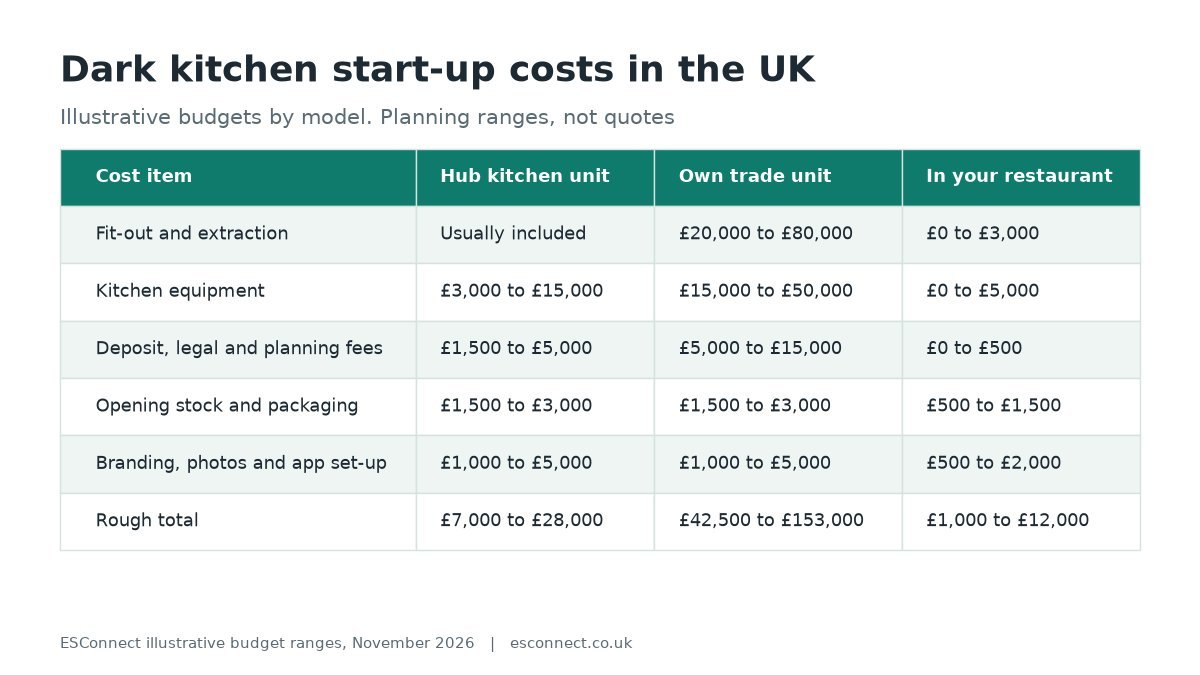
Treat these as planning ranges, not quotes. Your region, second-hand kit and whether the unit already has gas, three-phase power and a flue all move the total.
Keep three months of fixed costs in reserve, because reviews and app ranking take time to build. Our restaurant equipment checklist helps you price the kit line by line.
Dark Kitchen Profit per Order: A Worked £ Example
On a £25 delivery order, a dark kitchen may keep only about £6 for staff, rent and energy. This example follows a burger brand on a marketplace app with 30% commission.
Contribution per order = net sales minus commission minus food cost minus packaging
| Line | £ per order | Note |
|---|---|---|
| Customer pays for food (VAT included) | £25.00 | Delivery fee goes to the app |
| VAT on hot food at 20% | £4.17 | Paid to HMRC |
| Net sales | £20.83 | What the business earns |
| App commission (30% of £25.00) | £7.50 | Plus £1.50 VAT, reclaimable if VAT-registered |
| Food cost (30% of net sales) | £6.25 | Ingredients only |
| Packaging | £0.90 | Box, bag, dip pots, seal |
| Contribution | £6.18 | 24.7% of what the customer paid |
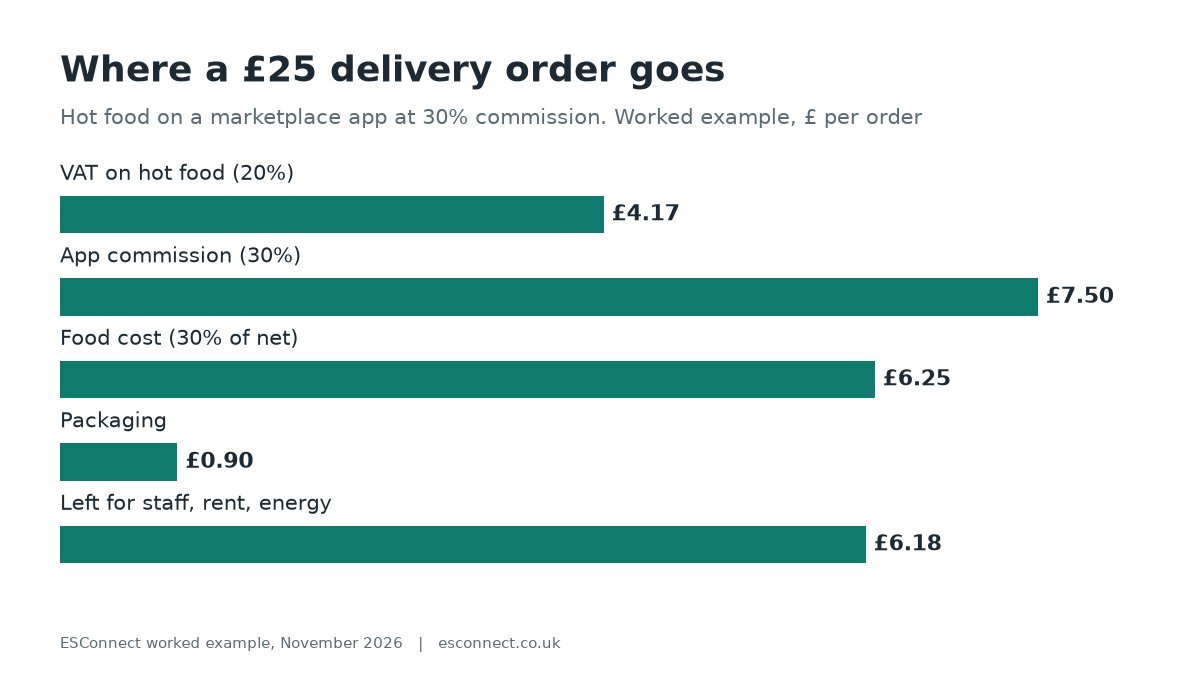
The table leaves out costs that vary by app: paid promotions, sponsored listings and refunds for missing items. Most apps also offer a lower commission rate if you deliver with your own riders.
How many orders a dark kitchen needs to break even
Now add fixed costs. Say the unit costs £600 a week, labour £1,250, energy £150 and other overheads £200. That is £2,200 a week, so you need 356 orders a week, about 51 a day over seven days, just to break even.
The £1,250 buys roughly 80 hours of kitchen time at about £15.50 an hour with employer costs, and it leaves out the owner’s own pay. New brands rarely reach break-even in the first weeks, and order numbers vary widely by area and cuisine.
Price is the strongest lever. Raise app prices by 10% to £27.50 and contribution rises to £7.52, because the dish costs the same to make. Break-even then falls to 293 orders a week, if no customers drop away, so test a rise on one brand first.
Decision rule: keep food plus packaging under 35% of net sales on every app menu. Here it is 34.3%, so one supplier price rise would tip it over. Our guide on how to calculate food cost shows the dish-level maths.
How to Set Up Suppliers for a Delivery-Only Kitchen
Supplier set-up decides whether a dark kitchen can hold its food cost. Small units buy small amounts, so delivery charges and minimum orders bite harder than in a busy restaurant.
Build one ingredient list across every brand
Several brands only work from one dark kitchen if they share most of their stock. As a rule, each new brand should add no more than six to eight new product lines.
Check deliveries can reach you
Hub sites and industrial estates often limit delivery hours and loading space. Confirm who signs for goods and where chilled stock waits before you pick suppliers.
Chilled food must be kept at 8°C or below in England, and many kitchens reject deliveries above 5°C. Put both figures on the goods-in sheet.
Order less often, in bigger drops
A unit placing £150 orders six days a week loses margin to delivery charges. Set par levels and move to two or three drops a week where shelf life allows.
Minimum order values matter too. Our guide to how delivery costs affect procurement shows when it pays to consolidate suppliers.
Plan for substitutions
When a supplier swaps a bun at 6am, the app listing and allergen sheet must change before service. Agree substitution rules in writing and ask for a spec sheet with every swap.
New businesses often start on pro forma terms, so send credit applications early. Your supply chain management plan should also name a back-up supplier for every core line.
Why Packaging Is the Hidden Food Cost in Delivery
Packaging is a food cost in delivery, not an overhead. A box, bag, dip pots and a tamper seal can add 50p to £1.20 per order, so cost it into each dish.
Three sets of rules now shape what you buy:
- Single-use plastics ban: since 1 October 2023, England has banned single-use plastic cutlery, balloon sticks and polystyrene food and drink containers. Plastic plates, trays and bowls are restricted, but still allowed as packaging filled at the point of sale.
- Packaging EPR: for a small operator, the supplier of empty takeaway packaging usually carries the extended producer responsibility fees and passes them on in its prices. Groups with over £2 million turnover and more than 50 tonnes of packaging a year must report and pay fees themselves.
- Deposit Return Scheme: from 1 October 2027, drinks cans and plastic bottles in England and Northern Ireland will carry a flat 20p deposit. Expect deposits on your drinks invoices and in your app prices.
Test every pack before launch. Leave a finished order in the bag for 20 minutes, then check for steam, soggy chips and leaks.
Food waste rules apply too. Under Simpler Recycling in England, firms with fewer than 10 staff must separate food waste from 31 March 2027, as our guide to food waste legislation explains.
How to Start a Dark Kitchen in 7 Steps
To start a dark kitchen, prove demand first. Then lock in the site, menu, paperwork and suppliers, in this order.
Step 1: Check demand in your delivery radius
Open the apps at your target postcode at 7pm on a Friday. Count the brands in your cuisine and note their prices. Then look for a gap with few options under 30 minutes.
Step 2: Choose the model and the site
Test in a hub unit or inside your restaurant first. Only lease your own unit once the brand holds steady sales for three months.
Step 3: Design a menu that travels
Keep it to 8 to 12 dishes that still taste right after 30 minutes in a bag. The principles of menu engineering help you push the dishes that earn most per order.
Step 4: Register, licence and insure
Register 28 days ahead, apply for any late-night licence and arrange employers’ liability and product liability cover. These are the same core steps as when you open a restaurant.
Step 5: Set up suppliers and packaging
Start with two or three core food suppliers and one packaging supplier. Agree delivery days, minimum orders and spec sheets before the first order goes live.
Step 6: Lay out the dark kitchen for speed
Give the pass a packing station, a bag-sealing point and a rider waiting spot away from the cooks.
Step 7: Soft launch on one app
Trade for two weeks on a single app with limited hours. Track prep time, refunds and ratings, then add apps and brands once the line runs cleanly.
Is a Delivery-Only Kitchen a Good Business in 2026?
It can be, when rent is low, the menu travels well and app prices cover the commission.
| Pros | Cons |
|---|---|
| Lower rent than a high street site | Commission takes a large share of each order |
| No front-of-house wages | No walk-in trade or street visibility |
| New concepts tested in weeks | App ranking and reviews drive sales |
| Several brands from one kitchen | Customer data stays with the app |
2027 adds pressure. The National Living Wage rises 3.9% from April 2027, and forecasts point to higher food inflation in 2027. Both bite harder in delivery, because commission already takes such a large slice.
The apps have new owners too. DoorDash bought Deliveroo in 2025, and Prosus took over Just Eat Takeaway.com the same year, so check each partner notice for changes to commission plans and fees.
6 Costly Mistakes New Delivery Operators Make
Watch for these six mistakes in the first months of trading.
1. Copying dine-in prices onto the apps
A dish that makes 70% gross profit in the dining room can lose money after commission and packaging. Price each app menu from its own costing.
2. Paying for promotions without a ceiling
Sponsored listings and “20% off” offers come out of your margin. Set a weekly promotion budget and drop any offer that does not bring customers back.
3. Launching too many brands at once
Four brands with four sets of stock means slow tickets, more waste and confused staff. Start with one, and add a second only if it shares most ingredients.
4. Ignoring refund deductions
Apps take refunds for missing or wrong items out of your payout. Check every statement, photograph sealed bags at the pass and challenge deductions you can disprove.
5. Staffing for an average night, not the peak
Many delivery orders land in a short evening window. If one cook is on at 7pm on a Friday, ticket times climb, ratings slip and fewer customers see you.
6. Relying on one app
A rating dip or a ranking change can halve your orders overnight. Spread sales across two or three apps, and build direct orders through your own website and Google Business Profile.
Dark Kitchen Launch Checklist
Run through these points before you take the first order:
- Demand checked on the apps at your postcode at peak times
- Planning position confirmed with the council in writing
- Food business registered at least 28 days before trading
- Late night refreshment and alcohol licences in place if needed
- Allergens in each dish shown on every app listing and in the bag
- Every dish costed with packaging, VAT and commission
- Two or three core suppliers with agreed delivery days and spec sheets
- Break-even orders per week worked out and tracked from week one
Final Thoughts
A dark kitchen follows the same food, planning and licensing rules as any takeaway, plus the duties of selling at a distance. Build those into the plan from day one.
Then work out what each order leaves after VAT, commission, food and packaging. If that cannot cover your fixed costs at a realistic order count, change the menu, prices or model before you sign a lease.
If you want a second view of the numbers, ESConnect’s catering consultancy team can review a delivery concept, its menu costs and its supplier set-up before you commit.
Contact the ESConnect team to talk it through.
Frequently Asked Questions
1. Why is it called a dark kitchen?
It is called a dark kitchen because the customer-facing side is “dark”. There is no dining room, counter or sign for the public. The kitchen trades all day through delivery and collection apps, so from the street it often looks like a closed unit.
2. Is a ghost kitchen the same as a dark kitchen?
Yes. Ghost kitchen is the usual American name, and cloud kitchen turns up in Indian and Gulf markets. UK operators, councils and the Food Standards Agency mostly say dark kitchen, so that is the term to use in planning and licence applications.
3. Can you run a dark kitchen from home?
Yes, on a small scale, if you register with your council and pass a hygiene inspection. Check your mortgage or tenancy, your insurance and whether the council sees it as a change of use.
4. Do dark kitchens get food hygiene ratings?
Yes. Delivery-only sites are registered food businesses, so councils inspect and rate them. England, Wales and Northern Ireland use a 0 to 5 score, and Scotland uses Pass or Improvement Required. Display is compulsory in Wales and Northern Ireland but voluntary in England.
5. How quickly can a new dark kitchen open?
A hub kitchen unit can open in four to eight weeks, because planning and extraction are already in place. Your own trade unit takes longer. Allow three to six months, since a planning decision alone can take eight weeks or more.
6. Do I need to register for VAT to sell on delivery apps?
You must register once taxable turnover passes £90,000 in any rolling 12 months. Hot takeaway food is standard-rated at 20%, while most cold takeaway food is zero-rated. HMRC’s VAT Notice 709/1 explains which items count as hot.
7. Can a restaurant run a dark kitchen brand from its existing kitchen?
Yes, but check two things first. Update your food business registration with the council, and ask the planning team whether a large delivery operation changes the use of your premises. Then add the brand’s allergen information and confirm your insurance covers it.
8. What food works best in a dark kitchen?
Food that holds its heat and texture for 20 to 30 minutes works best. Think burgers, curries, rice bowls, wraps, pizza and loaded fries. Crisp tempura and soufflés rarely survive the trip.
9. Can a dark kitchen sell alcohol?
Yes, if the premises licence allows off-sales of alcohol and a personal licence holder acts as designated premises supervisor. Riders must check age on delivery, and many operators follow a Challenge 25 policy at the door.
10. Is it cheaper for a dark kitchen to use its own drivers?
Sometimes. Apps usually charge a lower commission when you deliver with your own riders, but you then pay wages, vehicles and insurance. It tends to pay only in a tight delivery radius where orders are steady enough to keep each driver busy every hour.