
Restaurant failure is rarer in the first year than the famous “60% close in year one” claim suggests, yet far more common by year five. In the UK it tends to build slowly, as thin gross profit, heavy fixed costs and supplier prices that outrun menu prices wear down the cash a site opened with.
The Insolvency Service recorded 3,208 company insolvencies in accommodation and food in England and Wales in the 12 months to September 2026. That is about one in seven of all company insolvencies where the trade was recorded.
This guide tests restaurant failure figures against UK data and sets out nine common causes that close sites. You also get weekly warning signs, a £ example and your options if trade is already slipping.
Most of these causes show up in a margin and supplier review months before the bank account empties. Your accountant, a fellow owner or a restaurant consultancy service can run one for you.
Jump to a section:
- What it means
- UK numbers
- The 60% myth
- 9 causes
- Warning signs
- £ example
- Supplier costs
- 7 steps to prevent it
- If you are struggling
- Checklist
- FAQs
What Is Restaurant Failure?
Restaurant failure means a restaurant closes because it can no longer pay its way. That includes formal insolvency, such as liquidation or administration. It also includes owners who shut the doors before the debts grow.
Not every closure is a restaurant failure, though. Owners sell up, retire or leave when a lease ends. Groups close profitable sites too, which is one reason the figures online disagree so much.
Three UK measures count three different things:
| Measure | What it counts | Who publishes it |
|---|---|---|
| Business survival | Businesses still registered for VAT or PAYE a set number of years after they started | Office for National Statistics (ONS) |
| Company insolvencies | Limited companies entering liquidation, administration or a CVA | The Insolvency Service |
| Site closures | Outlets that close, usually shown net of openings | Market trackers in the trade press |
So when someone quotes a restaurant failure rate, ask what it measures. A sole trader who quietly closes never appears in company insolvency figures. A group that shuts ten sites may count as ten closures and no failures.
How Many Restaurants Fail in the UK?
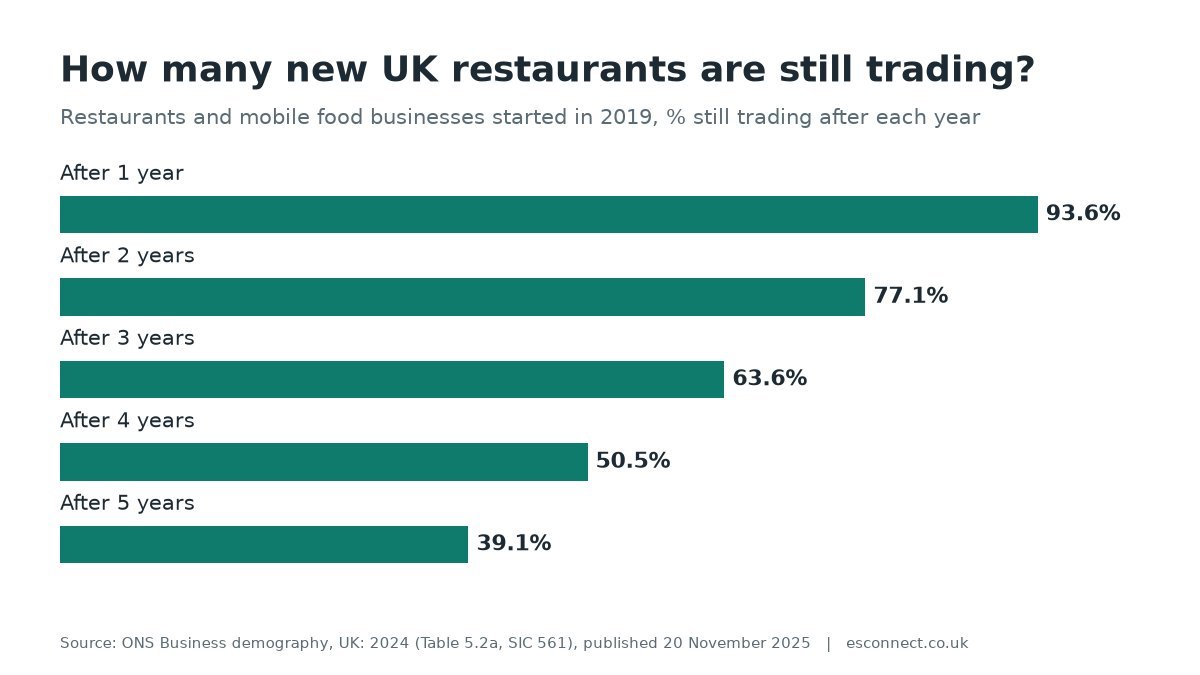
Roughly six in ten UK restaurants stop trading within five years, which is close to the average for all new businesses. So the honest figure depends on the time frame you pick.
| Time since opening | Restaurants still trading | All UK businesses still trading |
|---|---|---|
| 1 year | 93.6% | 94.6% |
| 2 years | 77.1% | 74.7% |
| 3 years | 63.6% | 55.9% |
| 4 years | 50.5% | 45.0% |
| 5 years | 39.1% | 38.4% |
The figures cover businesses that started in 2019, from ONS business demography data published on 20 November 2025. “Restaurants” means restaurants and mobile food businesses. The next edition is due on 19 November 2026.
Year one is not the cliff edge. More than 93 in 100 new restaurants were still trading after 12 months, and most restaurant failure comes in years two to five, once the opening money has gone.
Newer businesses are doing worse. Across the wider accommodation and food sector, 60.7% of the businesses that started in 2019 were still trading after three years. For those that started in 2021, the figure was only 50.2%.
The 2019 group also traded through lockdowns, when furlough and emergency loans kept some weak businesses alive. Treat the figures as the shape of the risk rather than a forecast for your site.
The Insolvency Service’s figures show the same restaurant failure pattern from another angle. In 2025 the sector had 268 insolvencies per 10,000 businesses, against 116 across all industries. It has had the highest rate of any sector every year since 2015.
Is the 60% Restaurant Failure Rate True?
No. The 60% restaurant failure rate is real data stretched out of shape. It comes from a 2005 study by H.G. Parsa and colleagues of 2,439 restaurants in Columbus, Ohio, between 1996 and 1999.
The study counted restaurants that closed or changed owners. About 26% did so in year one, and about 60% within three years. Over time, “60% within three years” became “60% in the first year”. US software blogs still repeat it.
The even bigger claim, a 90% restaurant failure rate in year one, has less behind it. The study’s own authors tested it and called it implausible.
UK data gives a fairer picture. On the ONS figures, about 6% of new restaurants stop trading in year one and about 61% by year five. That is a hard trade, but it is not the coin toss the myth describes.
Why Restaurants Fail: 9 Common Causes
Most restaurant failure starts on the spreadsheet long before it reaches the plate. These are nine common causes, each with a quick way to check your own site.
1. Opening With Too Little Cash
Fit-outs overrun and early sales rarely hit the forecast. Spend every pound on the build and there is nothing left for a slow February or a broken combi oven.
Check it: count how many weeks of rent, wages and loan repayments your bank balance covers. Our guide on how to open a restaurant shows how to build a reserve into the opening budget.
2. Fixed Costs the Site Cannot Carry
Rent, business rates and energy do not fall in a bad month. Upward-only rent reviews and a personal guarantee can turn a weak site into a personal debt, and many rates bills moved again with the April 2026 revaluation.
Check it: divide annual rent by net sales. Many operators see 8-10% as comfortable and anything over 12% as a warning. Then add your business rates for hospitality and energy bills on top.
3. Food Cost Creep, the Quiet Cause of Restaurant Failure
Supplier prices rise a few pence at a time, and the dishes never get re-costed. Gross profit (GP) slides from 70% to 66% without anyone touching the menu.
Check it: compare actual food cost with your recipe sheets. If dishes have not been costed lately, start with how to calculate food cost.
4. Labour Costs Out of Line With Covers
Rotas often get built on the covers you hope for rather than the ones you get. The National Living Wage rises every April and employer National Insurance went up in 2025, so labour can pass 35% of sales quickly.
Check it: track labour as a share of net sales each week, by day part. See how to protect gross profit when wages rise for the menu side.
5. A Menu That Is Too Long
Every extra dish adds stock, prep and waste. A 40-item menu at a 60-cover site often hides a dozen dishes that sell twice a week and tie up cash in the walk-in.
Check it: rank dishes by sales and cash margin. Menu engineering shows which to keep, reprice or cut.
6. Loose Supplier Terms and Paperwork
Short deliveries signed for at 7am, unchased credit notes, small-drop charges and pricier substitutions all leak cash. Together they can cost a few hundred pounds a month.
Check it: match ten of last month’s invoices to the delivery notes and the agreed prices.
7. Too Few Covers on Quiet Days
A site can be full on Friday and still lose money across the week, because Monday to Wednesday decide whether the fixed costs get paid. Delivery apps help fill quiet nights, but commission that often runs at 25-35% of the order can leave little or nothing.
Check it: count covers and average spend by day for a month, then see which days pay their own wages.
8. No Weekly Numbers
Quarterly accounts arrive weeks after the damage is done. By then a poor quarter has already eaten the cash buffer, which is why restaurant failure so often catches owners by surprise.
Check it: can you state last week’s sales, GP, labour percentage and bank balance by Monday lunchtime?
9. Owner Burnout
Many independents run on one person who cooks, orders, cashes up and writes the rota. When that person is ill or exhausted, standards and control slip together.
Check it: list the jobs only you can do. Each one is a single point of failure.
Restaurant Failure Warning Signs to Check Every Week
The early signs of restaurant failure show up in the numbers weeks before the dining room empties. If two figures sit in the act-now column for a month, deal with them straight away rather than waiting for the year-end accounts.
| Weekly number | Healthy | Watch | Act now |
|---|---|---|---|
| Food GP vs recipe-sheet GP | Within 2 points | 2-3 points below | 3+ points below for two weeks |
| Labour as % of net sales | 28-32% | 32-35% | Over 35% for four weeks |
| Prime cost (food plus labour) | Under 60% | 60-65% | Over 65% |
| Rent as % of net sales | Under 10% | 10-12% | Over 12% |
| Cash in the bank | 8+ weeks of fixed costs | 4-8 weeks | Under 4 weeks |
| Supplier accounts | Paid on agreed terms | One or two paid late | Accounts on stop |
| VAT and PAYE | Paid on time | Paid at the last minute | Missed or deferred |
These are rules of thumb for a full-service restaurant, not targets set by any regulator. Judge the trend against your own budget first.
Keep an eye on the supplier line. Suppliers often see restaurant failure coming before the accountant does, because a business short of cash pays them late first.
Restaurant Failure Example: What a 3-Point GP Slip Does to a 60-Cover Site
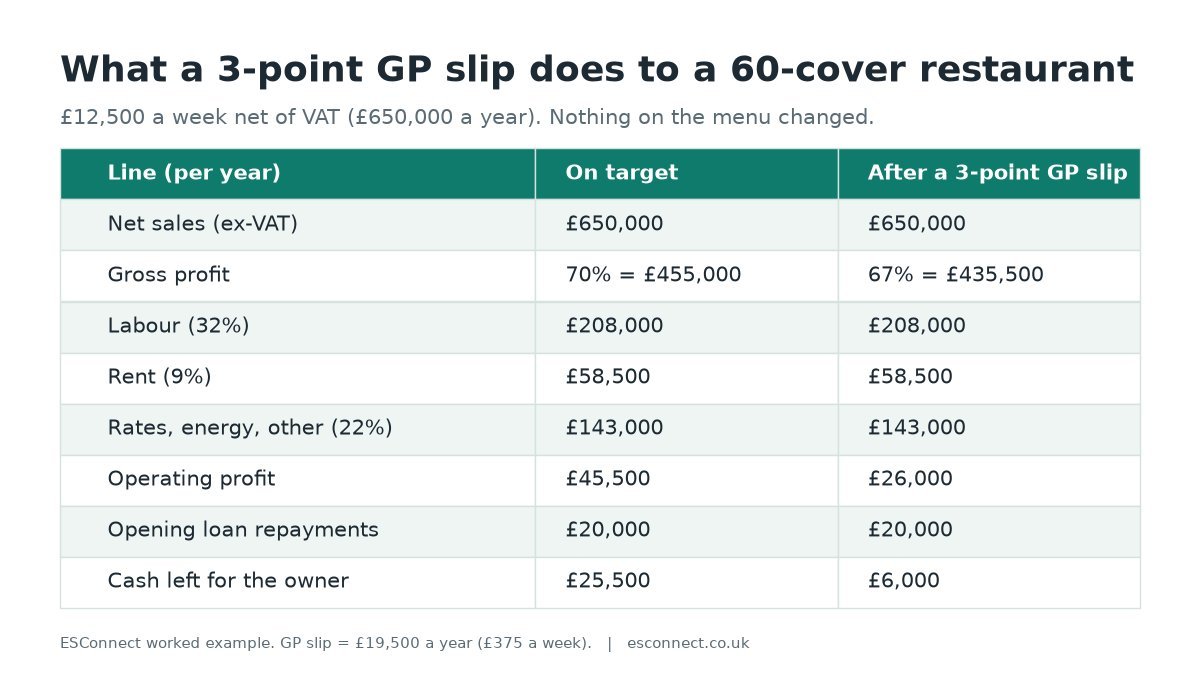
This restaurant failure example shows how a small slip in GP can wipe out most of an owner’s income with no drop in trade. Take a 60-cover neighbourhood restaurant taking £12,500 a week net of VAT, or £650,000 a year.
| Line (per year) | On target | After a 3-point GP slip |
|---|---|---|
| Net sales (ex-VAT) | £650,000 | £650,000 |
| Gross profit | 70% = £455,000 | 67% = £435,500 |
| Labour (32%) | £208,000 | £208,000 |
| Rent (9%) | £58,500 | £58,500 |
| Rates, energy and other overheads (22%) | £143,000 | £143,000 |
| Operating profit | £45,500 | £26,000 |
| Opening loan repayments | £20,000 | £20,000 |
| Cash left for the owner | £25,500 | £6,000 |
Three points of GP is £19,500 a year, or £375 a week. Nothing on the menu changed, and the dining room looks just as busy. The slip also lifts prime cost from 62% to 65%, right on the act-now line.
Here, the three points come from four small leaks:
- Supplier price rises not passed on: 1.2 points (£7,800)
- Portions drifting larger on busy nights: 0.8 points (£5,200)
- Waste and comps nobody records: 0.6 points (£3,900)
- Staff food and stock moved without a note: 0.4 points (£2,600)
The owner is left with about £115 a week. One quiet January or one broken fridge can then tip a busy site into restaurant failure. Our guide to improving restaurant profit margins shows where to win the points back.
How Do Supplier Costs Lead to Restaurant Failure?
Supplier costs lead to restaurant failure when prices rise faster than you re-cost and reprice. Most restaurants change menu prices once or twice a year, while supplier price files can move every month.
Prices paid by UK foodservice operators rose 0.9% in September 2026 alone, taking the NIQ x Prestige Foodservice Price Index to 155.5. Our example restaurant spends about £3,750 a week on food and drink. That single month adds about £34 a week, or £1,755 a year, if menu prices stay put.
The paperwork often hurts more than the headline price. Watch for:
- Price files changed without notice, so invoices no longer match the agreed price
- Credit notes for short or damaged deliveries that never arrive
- Payment terms cut from 30 days to 14 after one late payment
For the pricing side, read our guides on food inflation in 2027 and handling supplier price increases.
If you would rather not do this checking yourself, it is part of our restaurant procurement services. We compare what you pay with what you agreed, and with prices across our distributor network.
How to Prevent Restaurant Failure: 7 Steps
You prevent restaurant failure by watching cash and margin every week and fixing small leaks early.
Step 1: Keep a Cash Reserve
Once you are trading, keep at least eight weeks of fixed costs in the bank. New sites need more, ideally three to six months held back from the build budget.
Step 2: Re-Cost Your Top Sellers Monthly
Re-cost your 15 best sellers every month, and again whenever a key supplier changes its price file.
Step 3: Run a Monday Flash Report
Four numbers are enough: net sales, food GP, labour percentage and the bank balance. Compare them each Monday with last week and your budget.
Step 4: Put Supplier Terms in Writing
Agree prices, notice periods, delivery charges and credit-note rules in a food supplier contract, then check invoices against it.
Step 5: Cut Slow Sellers
Drop dishes that sell fewer than ten portions a week, unless they carry a high margin or bring people in.
Step 6: Count High-Value Stock Weekly
Proteins, alcohol and premium lines deserve a weekly count, even if the full stocktake is monthly. Good restaurant inventory management shows where GP is leaking.
Step 7: Get an Outside Review Before Restaurant Failure Looks Likely
Ask your accountant, a fellow owner or a consultant to go through your margins, supplier terms and cash forecast while you still have choices. Owners who wait until the bank calls usually find the options cost more.
What Should You Do if Your Restaurant Is Struggling?
Restaurant failure is not certain just because trade has slipped. Talk to the people you owe before you miss payments, because most creditors prefer a realistic plan to a formal insolvency that returns them only part of the debt.
Start with the informal options:
- Suppliers: ask for a short payment plan on old balances while you pay new deliveries on time.
- Landlord: ask about a rent deferral, monthly payments or a turnover-linked rent.
- HMRC: ask for a Time to Pay arrangement before a VAT or PAYE payment is due.
If the company cannot pay its debts as they fall due, take advice from a licensed insolvency practitioner. They may suggest a company voluntary arrangement (CVA), which needs the support of at least 75% by value of the creditors who vote.
Other routes include administration, which can protect the business while it is sold, and a creditors’ voluntary liquidation, which closes it in an orderly way.
Directors need to know one legal point. Once the company is insolvent or close to it, you must weigh creditors’ interests. If you keep trading after you knew, or should have known, that insolvent liquidation or administration could not be avoided, a court can order you to contribute personally.
Restaurant Failure Checklist
Run this restaurant failure checklist once a month with your head chef and whoever does the books.
- Bank balance covers at least eight weeks of fixed costs
- Every dish has a recipe sheet costed at current supplier prices
- Actual food GP is within two points of recipe-sheet GP
- Labour is at or below 32% of net sales over the last four weeks
- Rent is below 10% of net sales
- Last month’s invoices match delivery notes and agreed prices
- All credit notes for short or damaged deliveries are received
- No supplier account is on stop, and VAT and PAYE are up to date
- Dishes selling fewer than ten a week have been reviewed
- Someone else is learning the jobs that only you can do
Final Thoughts
Restaurant failure is rarely sudden, and the UK figures show it is less likely in year one than most owners fear. The real danger is the slow leak that runs for months before anyone looks.
So start cutting your restaurant failure risk this week with four jobs. Match ten invoices to their delivery notes, set up a Monday sheet with four numbers, re-cost your top 15 dishes and work out rent as a share of sales. If any figure lands in the act-now column, fix it within a month.
If you want a second pair of eyes on your margins or supplier terms, contact the ESConnect team for a review.
Frequently Asked Questions
1. What is the number one reason for restaurant failure?
Running out of cash is the usual final cause, but thin margins sit behind it. A restaurant can be full and still fail if food, labour and rent take too much of each pound. Most closures trace back to weak financial control.
2. Is bad food the main cause of restaurant failure?
Rarely on its own. Poor food loses customers, but plenty of well-reviewed restaurants close because the numbers do not work. High rent, dishes costed at last year’s prices or a rota built for a full room can sink a good kitchen.
3. Are restaurants struggling in the UK in 2026?
Many are. A survey for UKHospitality, the BBPA, the BII and Hospitality Ulster, run by CGA by NIQ in May and June 2026, found 23% of hospitality businesses trading at a loss. One in six said they were at risk of failure within a year.
4. Which restaurants are most likely to fail?
Single-site independents with high rent and thin cash reserves carry the highest restaurant failure risk, because one bad quarter has nowhere to go.
5. Can a restaurant recover after a bad first year?
Yes. A bad first year does not make restaurant failure certain if you act while there is still cash to fix the problem. Cut the menu, re-cost every dish, renegotiate supplier terms and match the rota to real covers.
6. Do suppliers get paid when a restaurant goes into administration?
Often only in part. Food and drink suppliers are usually unsecured creditors. They rank behind secured lenders, insolvency costs and preferential claims, including some unpaid staff wages and HMRC’s VAT and PAYE debts. That is why suppliers tighten credit terms fast once payments slip.
7. How much cash should a new restaurant keep in reserve?
Many advisers suggest holding three to six months of fixed costs back from the build budget. That means rent, core wages, loan repayments, insurance and energy.
8. Does restaurant failure affect the owner personally?
It can. A limited company usually protects your personal assets, but personal guarantees on a lease, loan or supplier account must still be paid. Directors can also face personal liability or disqualification if they keep trading once insolvent liquidation cannot be avoided.
9. Should I close my restaurant or try to sell it?
If the site still trades but no longer pays you a living, selling usually returns more than closing, because a buyer pays for the fit-out, licence and lease. If the company is insolvent, take advice from a licensed insolvency practitioner before selling anything, because a cheap sale can be challenged later.