
UK food inflation was 1.3% in September 2026, close to its lowest rate since 2021, but the main industry forecasts expect it to pass 6% by summer 2027. For restaurants, pubs and hotels, that makes the next few months the cheapest window to fix ingredient prices.
The Food and Drink Federation (FDF) predicts food prices will rise 5.5% across 2027 and peak at 6.4% in July. IGD, the grocery research charity, puts 2027 at 5.6% to 6.6% in its latest food inflation forecast. Both say the pressure has only been pushed back.
Operators already feel it coming. In UKHospitality’s October 2026 member survey, 88% named food and drink cost inflation as their biggest worry outside tax.
Most operators set next year’s menus and budgets between now and March. If you plan on today’s 1.3%, your procurement savings targets will be out of date by Easter.
This guide covers what food inflation means for hospitality, what the 2027 forecast says, which foods are most exposed and seven ways to protect gross profit (GP). You will also find a worked £ example for a 60-cover restaurant.
Jump to a section:
- What it means
- The 2027 forecast
- Why prices are rising again
- Foods most at risk
- Restaurants, pubs and hotels
- Other 2027 cost changes
- A 60-cover example
- 7 ways to protect margins
- Common mistakes
- How often to review
- Checklist
- FAQs
What Is Food Inflation?
Food inflation is the yearly change in the price of food and non-alcoholic drinks. In the UK, the Office for National Statistics (ONS) measures it every month as part of the Consumer Prices Index (CPI).
The figure tracks what households pay in shops. It does not track what a kitchen pays a wholesaler, so treat it as a direction of travel rather than your own number.
Even so, the ONS September 2026 release shows a gap that matters to every operator:
| ONS measure (UK) | 12 months to September 2026 |
|---|---|
| All items, CPI | 3.5% |
| Food and non-alcoholic beverages | 1.3% |
| Alcohol and tobacco | 2.5% |
| Restaurants and hotels | 3.8% |
Across the sector, menu and room prices are rising faster than shop food prices. While that gap lasts, it gives operators some margin room. It will not last if the food inflation forecasts are right.
What Is the Food Inflation Forecast for 2027?
Both main forecasts point sharply up. The FDF and IGD each expect next year’s average to be four to five times today’s rate.
| Source | Published | 2026 | 2027 | Note |
|---|---|---|---|---|
| ONS (actual) | 21 Oct 2026 | 1.3% in September | – | Next release 18 Nov 2026 |
| FDF | 9 Sep 2026 | 3.9% by December, 2.8% average | 5.5% average | Peak of 6.4% in July 2027 |
| IGD | 17 Sep 2026 | 2.9% to 3.9% average | 5.6% to 6.6% average | Still 5.3% to 6.3% in 2028 |
The FDF forecast also notes that 1.3% in July 2026 was the lowest rate since September 2021. In other words, the low point has probably passed.
Shop prices already show the turn. The British Retail Consortium’s shop price index put food at 2.9% in early October 2026, up from 2.5% in September. Ambient groceries jumped from 2.2% to 3.2%.

For a buyer, the timing matters more than the exact peak. Supplier price lists tend to move a few weeks after their own costs change, so the steepest rises are likely to reach your invoices in spring and early summer 2027.
Why Is Food Inflation Rising Again?
Food inflation is rising again because cost increases that manufacturers absorbed in 2026 are now feeding through to prices. The FDF sums up the pattern as “later and longer”.
The main drivers named by the FDF and IGD are:
- Energy: the FDF says gas now costs over twice what it did in February 2026, mainly because of the conflict in the Middle East. Energy-heavy lines such as bread, dairy and frozen food feel it first.
- Weather: UK drought and a severe El Niño have cut yields of fruit, vegetables and grains.
- Hedging running out: after 2022, many manufacturers fixed energy and commodity prices for longer. Those contracts delayed the rise, but they did not stop it.
- Packaging, transport and labour: every step between the farm and your kitchen door now costs more.
- Tax and regulation: the FDF lists the wider tax burden on manufacturers as a separate pressure.
Supermarkets also held prices down in 2026 to win shoppers. Wholesalers and foodservice distributors have less room to do that, so hospitality buyers often feel food price inflation before the official figure shows it.
Which Foods Will Rise Most in Price?
IGD expects fruit and vegetables to add more to food inflation than any other category, because short growing cycles leave them exposed to the weather. Energy-heavy and imported lines are the next group to watch.
| Category | Why it is exposed | What to do now |
|---|---|---|
| Fresh fruit and vegetables | Drought, El Niño, short crop cycles | Build seasonal UK swaps into your specs |
| Bread and bakery | Energy-heavy baking, grain prices | Compare par-baked and frozen options |
| Dairy | Energy, feed and processing costs | Agree a fixed review date for butter and cream |
| Beef and lamb | Tight UK cattle supply | Move braises to secondary cuts |
| Imported ambient goods | Shipping, currency, overseas weather | Forward-buy only with space and cash |
| Packaging and disposables | Energy and packaging costs | Fix prices for 6 to 12 months |
Our guide to why beef prices are so high covers the protein side in detail. If fresh produce is your biggest spend, ask your fruit and veg wholesalers for a weekly market report, so a rise never arrives as a surprise.
How Food Inflation Hits Restaurants, Pubs and Hotels
Food inflation does not hit every venue the same way. Your exposure depends on how much of your sales is food, how fresh your menu is and how far ahead you sell at a fixed price.
| Venue | Biggest exposure | Watch point |
|---|---|---|
| Independent restaurant | Fresh produce, proteins, dairy | Menus printed for a whole season |
| Pub | Food and drink together | Alcohol duty rises 4.55% on 1 February 2027 |
| Hotel | Breakfast (eggs, dairy, bakery, coffee) and banqueting | Weddings and conferences sold 12 to 18 months ahead |
| Contract caterer | Fixed-price contracts | Review clauses that lag real costs |
Hotels and caterers carry the hidden risk. A wedding package sold today at a fixed price per head will be served in mid-2027, right at the forecast food inflation peak. So price event food for dates after March 2027 at least 6% above today’s costs.
Guests feel the squeeze too. When household bills rise, diners trade down, and a large menu price jump can cost you covers. That is why the buying side has to carry part of the load.
What Else Lands in 2027 Alongside Rising Food Prices?
Food inflation is only one line in the 2027 cost stack. The Budget on 28 October 2026 confirmed several changes that arrive in the same months as the food inflation peak.
| Date | Change | What it means for you |
|---|---|---|
| 26 Nov 2026 | Tariffs suspended on 101 more imported food products, to 31 Dec 2028 | A small saving on some imports, if suppliers pass it on |
| 1 Feb 2027 | Alcohol duty up 4.55% | Higher drinks costs for pubs and bars |
| 1 Apr 2027 | National Living Wage up 3.9% to £13.21 an hour | Higher kitchen and front-of-house wages |
| 1 Apr 2027 | Small business rates relief for retail, hospitality and leisure (England): 100% up to £18,000 rateable value, tapering to £21,000 | Lower rates bills for some smaller sites in England |
| July 2027 | Forecast food inflation peak of 6.4% (FDF) | The highest pressure on ingredient costs |
Ask every supplier who imports affected lines to show the tariff saving on their December price file. Nobody passes on a saving they are not asked about.
For the labour side, see how to protect gross profit when wages rise. Our plan for business rates and hospitality profitability covers the property side.
Food Inflation Example: A 60-Cover Restaurant in 2027
These are round numbers for a 60-cover independent restaurant. All figures exclude VAT, and the example applies the year-on-year forecast to today’s basket to keep the sums simple.
- Monthly food sales: £32,000
- Monthly food purchases: £9,600
- Food cost: 30.0%, so GP on food is 70.0%
Food cost % = food purchases ÷ food sales (ex VAT) × 100
Suppose the restaurant’s basket rises in line with the FDF’s 2027 food inflation average of 5.5% and nothing else changes. Food purchases rise to £10,128 a month and food cost moves to 31.7%. That is £528 a month, or £6,336 a year, straight off profit.
| Scenario | Food purchases | Food sales | Food cost | GP |
|---|---|---|---|---|
| Today | £9,600 | £32,000 | 30.0% | 70.0% |
| 2027 average (+5.5%), no action | £10,128 | £32,000 | 31.7% | 68.3% |
| July 2027 peak (+6.4%), no action | £10,214 | £32,000 | 31.9% | 68.1% |
| +5.5%, with a 3% buying saving and a 2.5% menu rise | £9,824 | £32,800 | 30.0% | 70.0% |
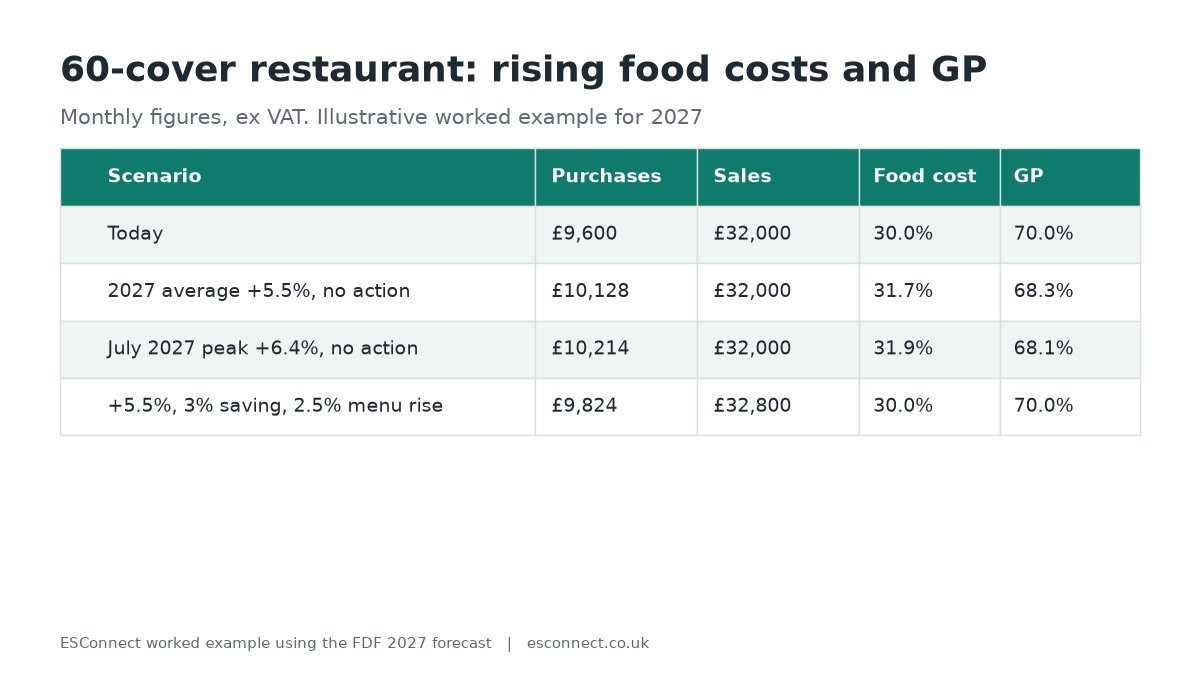
Holding a 70% GP with menu prices alone needs a 5.5% rise. Holding the same cash profit needs only about 1.65% (£528 ÷ £32,000). In this example, an assumed 3% buying saving plus a 2.5% price rise does both, and leaves about £576 a month more gross profit than today.
Your own numbers will differ, so run the same sum on your top 20 lines. Our guide on how to calculate food cost in a restaurant shows the dish-level method.
7 Ways to Protect Your Margins From Food Inflation
The best defence against food inflation mixes buying, menu and kitchen actions. Start with the steps that fix today’s prices, because that window closes first.
1. Fix prices on stable lines now
Ask your main suppliers for 6 to 12-month fixed prices on high-volume lines such as oils, flour, rice, frozen chips and tinned tomatoes. With shop food prices still rising under 3%, you are negotiating from a low base.
Write the agreed prices and the volume you commit to into the price file. A fixed price with no volume attached is easy for a supplier to drop. Our tips on negotiating better food prices help you prepare.
2. Ask for a cost breakdown on every rise
When a price increase arrives, ask what share comes from raw materials, energy, labour and transport. Then check each part against the latest FDF and ONS food inflation figures. Our guide to responding to supplier price increases covers the reply.
3. Add a food inflation clause to longer contracts
For contracts over six months, link price reviews to a published index, such as the ONS food and non-alcoholic beverages series. Set a review date every quarter and agree no change unless the index moves more than 2%.
Sample wording: “Prices are fixed to 31 March 2027, then reviewed quarterly. They change only if the ONS food index moves by more than 2%, and by no more than that movement.”
4. Re-spec before you re-price
Test cheaper specs that guests will not notice: a different grade of tinned tomatoes, frozen berries for a coulis, a secondary cut for braises. Yield-test each swap on the pass, not on paper.
5. Re-cost dishes and use menu engineering
Re-cost every dish on current invoice prices. Then promote the high-GP dishes through menu placement and staff upselling. Our menu engineering steps explain how to sort stars, puzzles and plough horses.
6. Cut waste on the lines that are rising
Every kilo you bin is bought at next year’s price. Tighter prep lists, lower par levels on fresh lines and a weekly waste log pay back faster when prices climb. See our practical tips to reduce food waste.
7. Benchmark and consolidate suppliers
Compare your highest-spend lines with a second supplier every quarter. Fewer, larger accounts can win better prices and lower delivery charges, but keep a backup for critical lines. Weigh up single and multiple supplier strategies before you cut accounts.
Common Food Inflation Mistakes to Avoid
Most margin losses during food inflation come from everyday buying habits. These four are the most common.
Using CPI as your benchmark
The ONS figure covers a household shopping basket. A steak restaurant buys mostly protein and dairy, so its own food inflation can run well above or below the headline rate.
Accepting blanket increases
A letter saying “all prices up 6% from 1 January” is an opening offer. Ask for line-by-line prices and challenge any line where the market has not moved.
Panic buying perishables
Stocking up on chilled or fresh goods ahead of a rise only moves cash into the bin. Forward-buy ambient or frozen lines only if you have the space, the cash and the shelf life.
Missing price drift on invoices
Small unannounced rises of 2p or 5p a unit are the hardest to spot. Match each invoice to the price file and chase credit notes for wrong prices. A clear purchase to pay process makes that routine.
How Often Should You Review Food Costs in 2027?
Review food costs more often while food inflation is rising. A simple rhythm works for most venues:
- Weekly: check invoice prices on your top 20 lines against the price file.
- Monthly: work out food cost % and GP from stock counts and purchases.
- Quarterly: re-cost every dish and benchmark key lines with a second supplier.
- On each ONS release: compare the official food inflation rate with your own basket. The next one is due on 18 November 2026.
Also review straight away if a single line rises more than 10%, or if GP drops by more than one point in a month.
Food Inflation Checklist for 2027
Run through this list before you sign off your 2027 budget:
- List your top 20 lines by spend and note today’s price for each.
- Ask your main suppliers for 6 to 12-month fixed prices before January.
- Request a December price file that shows any tariff savings.
- Add an index-linked review clause to new contracts.
- Re-cost every dish and flag those below your target GP.
- Price event food for dates after March 2027 at least 6% above today’s costs.
- Set a weekly invoice check and a monthly GP report.
- Plan menu price changes in two small steps, not one big jump.
Final Thoughts
Food inflation looks calm today, but the FDF and IGD both expect it to reach 5.5% to 6.6% in 2027, with the steepest point around July.
Two moves matter most over the next three months. Lock in what you can at today’s prices, and plan menu changes in small steps instead of one large rise in spring.
Most of these levers need time and buying data that a busy GM or head chef rarely has. That is where a hospitality procurement partner helps. ESConnect works with UK restaurants, hotels, pubs and caterers from New Covent Garden Market in London. We compare supplier prices and use our buying power and volume-based discounts to negotiate better terms before food inflation reaches your price list.
If you want a second pair of eyes on your price file before you sign 2027 contracts, talk to the ESConnect team.
Frequently Asked Questions
1. How is food inflation measured in the UK?
The ONS measures it each month as part of the Consumer Prices Index. It tracks the price of a basket of food and non-alcoholic drinks that households buy, then compares it with the same month a year earlier. Figures for each month come out in the middle of the following month.
2. What was UK food inflation in 2025?
It climbed for most of 2025. The House of Commons Library shows a rate of 2.0% at the end of 2024 rising to 5.1% by August 2025, then easing to 4.2% in November. It kept falling into 2026 and reached 1.3% in July, its lowest rate since 2021.
3. When will food prices go down in the UK?
Food prices rarely fall back once they rise. Slower inflation only means they rise more slowly. IGD expects food inflation to stay between 5.3% and 6.3% in 2028, so it would be unwise to budget for cheaper ingredients in 2027 or 2028.
4. How much have UK food prices risen since 2020?
UK food prices rose 38.6% in total between November 2020 and November 2025, based on Commons Library analysis of ONS data. Most of that came from late 2021 to mid-2023, and food inflation peaked at 19.1% in March 2023, the highest rate since 1977.
5. Why does food inflation feel higher in a kitchen than the official figure?
The official figure averages a broad basket of around 200 everyday items, and many of them barely move. A kitchen buys a narrower mix of proteins, dairy, oils and fresh produce, often the most volatile lines. Delivery charges and minimum-order surcharges add cost that never shows up in CPI.
6. What is the NIQ x Prestige Foodservice Price Index?
It is a monthly index from NIQ and Prestige Purchasing that tracks the prices hospitality businesses pay, rather than shop prices. The August 2026 edition stood at 154.1, up 2.7% on a year earlier. For operators, it is a closer benchmark than CPI.
7. What is the RPI food and catering index?
It is an older ONS series that combines shop food with catering, such as meals out and canteen meals. Some long-term supply and catering contracts still use RPI-based indices for price reviews. Check which index your contract names, because RPI usually runs higher than CPI.
8. Is food inflation higher than wage growth in 2027?
On current forecasts, yes. The National Living Wage rises 3.9% to £13.21 an hour from April 2027, while the FDF expects food prices to rise 5.5% across 2027. For operators, both costs climb at once and squeeze GP from two sides.
9. What product shortages could affect UK kitchens?
The main risks for 2027 are weather-hit fresh produce, tight beef supply and imports delayed by shipping problems. IGD warns that El Niño could affect yields, quality and availability well into 2027. Agree substitutes with your suppliers now, so a missing line means a planned swap rather than a 5am phone call.
10. How much should I raise menu prices when food inflation rises?
It depends on your goal. On a dish with a 30% food cost, a 6% ingredient rise needs only a 1.8% price rise to keep the same cash profit. To keep the same food cost percentage, you need the full 6%. Most operators land between the two.